
Drowned Land
Season 11 Episode 1103 | 55m 52sVideo has Closed Captions
A filmmaker probes dams, displacement, and family legacy.
In Oklahoma’s Choctaw Nation, a proposed hydro-power plant on the Kiamichi River sparks a deeper inquiry into history and inheritance. As residents work to protect the river, the filmmaker investigates generations of displacement since the Trail of Tears—and her grandfather’s role designing dams that reshaped Native lands—examining memory, responsibility, and survival.
Problems playing video? | Closed Captioning Feedback
Problems playing video? | Closed Captioning Feedback
Support for Reel South is made possible by the ETV Endowment of South Carolina, National Endowment for the Arts, and Wyncote Foundation.
Drowned Land
Season 11 Episode 1103 | 55m 52sVideo has Closed Captions
In Oklahoma’s Choctaw Nation, a proposed hydro-power plant on the Kiamichi River sparks a deeper inquiry into history and inheritance. As residents work to protect the river, the filmmaker investigates generations of displacement since the Trail of Tears—and her grandfather’s role designing dams that reshaped Native lands—examining memory, responsibility, and survival.
Problems playing video? | Closed Captioning Feedback
Where to Watch REEL SOUTH
REEL SOUTH is available to stream on pbs.org and the PBS app.
Providing Support for PBS.org
Learn Moreabout PBS online sponsorship- She's the heart.
She's our home, provides life.
She's everything to who we are as people from this place, and our connection runs through her.
- This is gonna have generational impacts.
- You have generations of ancestors that you may possibly be letting down to try to protect the Kiamichi River.
(calm music) (water sloshing) - Oklahoma is hot.
I'm talking 110 degrees and 80% humidity.
But where I live, there is lots of water.
Rivers and lakes to cool off in.
In fact, there's more manmade lakes here than any other state.
I grew up going to these lakes, and every summer, you can find me there.
This is Grand Lake.
The full name is Grand Lake O' the Cherokees.
O' the Cherokees.
Grand Lake was one of the first manmade lakes in Oklahoma, it's a huge lake.
They flooded the area to displace a ton of people.
One time when I was a young adult, a friend was taking us around to all these little coves, just like this, and started saying all the names of the coves.
Such and such holler and such and such this.
And he said these are named after the communities that were here.
Most of them were Cherokee.
And when this lake was built in the early 1930s, their family had moved less than a hundred years earlier from their ancestral lands.
That's when I really started thinking about all of the people that had been displaced to create the lakes in Oklahoma.
And I've been thinking about it ever since.
Who was here?
Whose land is this?
Who had to move?
Who already came from that history of displacement had to move?
(pensive music) (wind chimes tinkling) - There was some good old people lived in this valley.
There wasn't nobody causing no trouble or nothing, everybody just got along good.
When they built the lake, they was gonna move the cemetery.
And people didn't want the cemetery moved, so they decided it'd just be cheaper to leave it, it wouldn't be moved.
They moved all the stones off and built it up 15 foot and then put the stones back.
And some people said they didn't put 'em back in the right place.
Just right down this way, just little ways, at the end of that, is where the post office was.
It was a pretty good little town one time.
What gets me more than anything?
Running all these people out.
And a bunch of 'em, they just grieved theirself to death 'cause they was raised here and didn't wanna leave here.
- They were getting by with the way they were living and doing all right.
And yet they lost their home that they'd had, maybe their parents had had the home before them, and they lost all that.
To me, if I'd been in their place, it would not have been worth it.
I don't think it would've been to you either, to do that and take their land away from 'em, for the government just to come in and do that.
(pensive music) - [Colleen] I never correlated when I was a kid going to the lake as my grandfather's work.
And now that's all I think about.
- Mm!
Treasure chest.
- [Colleen] Literally Grandpa's treasure chest.
- [Mark] This was his.
- Okay.
So this was, this was the Tulsa District of the Corps of Engineers.
And this is Eastern Oklahoma.
And all of these are manmade constructed lakes.
This is the slide rule.
Oh yeah.
It says "Personal Property, John E.
Turnbull."
Well, he's got his name on it three times.
(Johnna laughs) (gentle music) Okay, who is this?
- This is my dad.
- [Colleen] Mm-hmm.
- John Turnbull.
Jack.
- [Colleen] How old would he have been?
- 20?
19?
His first job out of engineering school was for the Corps of Engineers, and he retired from there.
- [Colleen] So what was his job?
- [Johnna] He was a civil engineer.
He helped design the dams, and he was in hydrology for a while.
- [Colleen] So hydroelectric dams?
- [Johnna] Well, most of them were flood control.
Some of them are for producing electricity.
But most of 'em just became recreational lakes.
He worked on Keystone Dam.
- [Colleen] He did?
- Yes.
And he was a whiz with a slide rule.
Here he is smoking his pipe.
(chuckles) - [Colleen] See, that's what I remember.
Grandpa being, like, quiet and calming.
And, of course, the pipe.
Do you remember Keystone being built?
- I do.
Kind of.
What I really remember is the sandbags along Riverside Drive along the river because they were afraid it was gonna flood.
I must've only been two or three years old.
So yeah, I remember the whoop-de-do about this is gonna keep Tulsa from flooding.
- [Colleen] So it was a big deal.
- [Johnna] It was a really big deal.
I know that he felt good about it to keep the city from flooding.
(gentle music) (gentle music continues) - [Colleen] I live in Tulsa, which was founded by the Muskogees on the banks of the Arkansas River when the United States also forced them to these lands.
My mom, like me, was born and raised here after her father moved here for his job with the Corps of Engineers.
The Arkansas River is now dammed at Lake Keystone, which my grandfather helped build.
Once called the oil capital of the world, Tulsa is a city built on extraction.
The discovery of oil in the area resulted in the murders of dozens of Osage people a hundred years ago.
At the same time, in 1921, the most prosperous Black community in America, Greenwood, was massacred by White Tulsans.
My neighborhood is adjacent to Greenwood, in the Cherokee nation, where blood and oil mix together in the land.
After the oil boom and the violence of the Greenwood massacre, settlers found another natural resource to extract and commodify.
- [Reporter] Here was the key to Oklahoma becoming a vastly powerful economic giant within Inland America: the state's 1,200 square miles of lakes.
A sea of inland water spread across the face of the Oklahoma Prairie.
As industry arrives and population grows, so grows demand for water, and it must be met.
The future does belong to Oklahoma, but it must be claimed.
(gentle music) (birds chirping) - [Reporter] In Southeastern Oklahoma, the fight to protect the Kiamichi River is heating up.
Residents are headed back to court to try and stop outside entities from taking their water.
(ethereal music) - The river feeds this whole valley.
So, this far ridge, mountain ridge, is the southern ridge of the Kiamichi Mountains.
And then back along the ridge line, that's the Kiamichi River.
This is where the hydroelectric plant's gonna go in.
It's going to drain every water well or affect every water well in this valley up to 500 feet.
That's everywhere that you can see.
This is the closest place to any major city.
It's the closest place to Oklahoma City, to Tulsa, to Dallas, to Longview, to Texarkana that has natural resources like this.
And they're being used by people that are not us.
But it always seems to kinda happen.
(bright music) - [Judge] Good morning, everybody.
We are here in the matter of the application of Tomlin Energy LLC for permit to use stream water in Pushmataha County, correct?
- The applicant, as the board and the court is aware, is required to publish notice in the two counties that are impacted by this application.
And it's our position that that notice in Choctaw County has been defective under 82.OS.105.11.
That publication, you're required to state a 30-day period for objections and protestants.
- It is our position that notice is proper and it has served its goal of bringing all interested parties here today.
- May I add to this, Your Honor?
What they're going to do affects the entire basin.
The Kiamichi River, if I'm not mistaken, begins up in the mountains that are in LeFlore County.
It goes through LeFlore, Latimer, Pushmataha.
Part of the basin is in Pittsburg and Atoka Counties.
There's Choctaw County.
It should've been published in all of those counties because it affects all of those counties, under the statute.
- Do you have the statute that says they have to publish in those counties?
- [Attorney] It's my interpretation of the statute that's been cited, Your Honor.
- [Judge] I got you.
Take 10-minute recess.
(pensive music) (pensive music continues) - So, Grandpa was instrumental in building these lakes that really changed the face of the state.
If Grandpa was sitting here with us right now and I was asking him, "Your work displaced a lot of people who often feel forgotten, especially when, like, a lot of those people, they're Choctaw."
Like, what do you think?
Purely speculating.
What do you think Grandpa would say to me?
- You know, there's just all this stuff that you have to consider.
- [Colleen] I mean, I don't think there's a right or wrong.
Yes, it did a lot of good, but you look at the people that were displaced.
You know, they are the farmers.
It's the lower income people.
It's the rural people.
- Right.
Isn't it always that way?
They're always the ones that are hurt.
- I mean, did he have any kind of, like, affect about it, or was it just kind of matter of fact?
- No, that was just the way it was.
You know, hey, yeah, I don't want Farmer Jones to lose his land, but we have billions of dollars of infrastructure that is going to have to continue to be fixed if this river keeps flooding.
And I think that's probably how he felt, how he would've felt.
(warm music) - [Colleen] You told me one time that, like, you would take, like, road trips to go to dams.
- [Johnna] Well, no, when we were on a road trip, if there was a dam, then we went to see it.
(laughs) - [Colleen] How many dams did you go to?
- [Johnna] God, I don't know.
I was in the backseat, I didn't care.
(chuckles) - [Colleen] Did you think they were cool?
- No.
I didn't think about 'em.
- Was Grandpa, like, nerding out?
Was he like, "This is a such-and-such-style dam"?
- No.
You know Grandpa wasn't like that.
- [Colleen] I don't know, I was four when he died.
(laughs) - Well, I mean, I'm sure he was, in his head, that, you know, you know, drive by it, and he'd look.
- [Colleen] My Choctaw grandpa embodied the quintessential American Dream.
He joined the U.S.
military, fought in World War II.
Then he was able to get an education and a good job with a pension.
That job with the same federal government that forced us off our homelands and an act of genocide.
That job which enabled my mom to get a college education and has benefited his grandkids, my sister and I, as well.
Grandpa was also one of those people that had both the scientific and the creative sides of his brain activated.
He made stained glass and he filmed home movies.
Did Grandpa just always have the camera?
(person laughs) - No.
Look, Colleen's doing the same exact thing that Grandpa used to do.
- I know.
Well, thank God we have a documentarian in the family.
(Johnna laughs) - [Child] I want to do something on the camera.
- [Colleen] You wanna do something on the camera?
- [Child] Yeah.
- [Colleen] What do you wanna do on the camera, Buddy?
- Push the button.
- [Colleen] Push the buttons.
(singer vocalizing) (wind whooshing) Why did you wanna come to Mississippi?
I don't know, sometimes, you know, you're just kind of, some people are pulled to the place where their ancestors came from.
(pensive music) (singer vocalizing) - [Colleen] Choctaw came out of the earth in what's now called Mississippi.
Nanih Waiya is the birthplace.
Our mother mound.
(singer vocalizing) Not far away on Dancing Rabbit Creek, monuments mark the site where our removal treaty was signed.
- [Johnna] "On September 27, 1830, the Choctaw Nation of Indians surrendered their lands to the U.S.
and removed west of the Mississippi."
That's it.
That's what it is.
(pensive music) (film whirring) ♪ Mm ♪ Mm ♪ Mm ♪ Mm - [Colleen] That site is now a cemetery.
♪ Mm ♪ Mm (birds chirping) - I wanna get to our good friend, the Tomlin Hydropower Project.
I've got his application right here.
I'll pass it around in a minute.
He's gonna build a 30-acre lake right on the banks of the river that's 60-foot deep.
He's gon' pump water out of that into this.
This lake is gonna be 200 acres.
Then, going up the mountain, this lake is gonna be a hundred acres.
This is a massive amount of shale and soil that he's gonna dig out there.
Where's that gonna go?
He's not gon' take it back to Dallas with him.
Shale, rock dust is all gonna wash down over time into the river.
- [Attendee] Well, these guys, they're investment managers out of Dallas.
- This is a water rights play.
It's who controls water rights.
I mean, they consider water the next goal.
- You know, we've gotta get together and stop it.
So, without further ado, Dr.
Ken Roberts, our president, has something to say.
- What seems to be happening that I can't keep up with, and we've been trying at this for three years, is that we keep having people come along and propose things like this, and we get very short notices in the newspaper that we have to act on.
So, but what makes me nervous about this is just things aren't seeming to be done right, they're definitely not done on the up and up.
All of us are stakeholders, and how many of you were at the closed door meeting?
So, we apparently don't count.
This is going to kill a river.
And for a lot of us, this isn't about money.
It's to preserve a culture, a way of life, a heritage that you just can't replace if you move to a city.
(pensive music) - Well, it's not just Choctaw people that live here and are dependent on these natural resources.
There's Choctaw people, there's Cherokee people.
I'm both.
I'm Cherokee and I'm Choctaw.
There's Creek.
There's people that have been living here for hundreds of years that are White people, that are White families that are affected by the decisions.
It was one of those "there's no way that's happening" type of assumptions.
- [Colleen] Isn't that just the story, though?
I mean, I think all the time about before removal and, like, how many of us must have been like, "There's no way.
They're not taking all of our land.
They're not"- - Right.
They're not gonna do this, right?
And then they do.
The number one concern right now is how is this going to affect our drinking water in this valley, and what are we gonna have access to?
But I don't think that we've really had an opportunity to study or see what type of effect that this is gonna have on any of the animals or flora or anything here.
You ask about grandchildren, and it's concerning that I'm not going to be able to bring them here and show them the things that I was shown.
It's so drastically changed just from when I was a child.
If the change happened at the same rate, we're sitting in a dry river.
It's pretty sad.
(gentle music) - [Attorney] I'd like to briefly walk through what the applicant, Tomlin Energy LLC, intends to prove during its case in chief in this matter.
State your name for the record, please, Sir.
- Sorry.
Daniel Otis Tomlin, Jr.
Pursuant to section 2 of the application you completed, what type of permit is Tomlin seeking here?
- Term permit.
- And what is the proposed ending date for that term permit?
- December of 2070.
- [Attorney] Do you believe that your plant will beneficially use the runoff water that it seeks approval for here today?
- Yes, Sir.
- [Attorney] No further questions at this time.
- Have you called any of the downstream landowners just to visit with them about your proposed use of the Kiamichi River water?
- No.
- You didn't ask them about how this would impact their domestic uses or existing appropriations?
- I didn't think it would.
- [Attorney] Let's talk about the construction of this.
Where's the diversion weir going?
- There is none.
- [Attorney] You know, I'm real curious about that.
If we could look at page five of Exhibit 1.
Would you read that whole paragraph into the record for us, please?
- "A small impoundment lake will be located near the Kiamichi River.
There'll be a small diversion weir," that's wrong.
- [Attorney] Well, you're the one who signed this.
- That's right.
- [Attorney] Now, you also said you hadn't contacted downstream users, quote, "I didn't think it would impact them."
What scientific basis led you to that conclusion?
- It wasn't a scientific basis.
It was confirmed by what our consultant says.
(tense music) (tense music continues) - This is exactly where I'm from.
So I was literally born in this town of Kosoma in some lady's house on the way to the hospital.
Well, a lot of times, without thinking much about the environmental consequence, we make big decisions that have everlasting changes to the environment.
The only way that we're able to make a difference is through science, to go out and to try to get people to even notice.
There's a whole list of of with the river.
Recently, the Oklahoma Water Resource Board gave Oklahoma City the permit to pump the water up to Oklahoma City from the Kiamichi River basin.
Whenever you decrease the water by that much, the water is not able to flow as well.
And it gets dirtier, which makes it absorb more sunshine.
All of this causes a temperature rise which further kills fish and mussel species.
Who cares?
They're just mussels.
But as they're often referred to, they are the river's liver.
They can filter about 25 gallons a day per mussel.
So they're providing water that's of quality to downstream users.
If this water is diverted, the worst case scenario would be that this isn't enough water for any species to survive, especially the cleaners of the water.
So what do you do if you're a downstream user and you have such low volume of such polluted water is that you need tremendous money to treat it.
None of these townships in the poorest counties of Oklahoma can afford to do that.
Worst case scenario, the water becomes so unusable that people will have to relocate.
(warm music) ♪ There's a full moon over Tulsa ♪ ♪ I hope it's shining on me ♪ Nights are getting colder in Cherokee County ♪ ♪ Blue Norther passing through ♪ You're the reason God made Oklahoma ♪ ♪ And I'm sure missing you ♪ I'm sure missing you (people cheering and clapping) (cricket chirping) (birds chirping) - They're under a boil order.
June 9th.
"EMERGENCY ALERT.
At this time we are unable to estimate when we will get water again.
We are under a MANDATORY BOIL ORDER!
DO NOT UNDER ANY CIRCUMSTANCES DRINK THE WATER WITHOUT FIRST BOILING IT!"
They built that lake so that people could use the water.
I'm all charged up again now.
(chuckles) This is just crazy.
Can you imagine how disheartening that is to have to update your community and just say, "Still no water," "Still no water," "Still no water," for six weeks in the middle of summer when it's 110 damn degrees outside?
This is gonna have generational impacts.
It is.
There's no way it's not.
There's no way it's not.
And I just sit here and I literally, like, I know we're doing this, like, we're doing it on camera, but, like, I literally feel sick.
And I... America has painted Oklahoma as this throwaway place.
A place that the federal government said, "The land's not worth anything, so we're gonna move all of these tribes here," and basically create giant reservation in what they called Indian territory.
It's not pretty, it's not worth anything unless America and the extractive powers that be can make something of it, either with oil, timber, coal, other resources, water.
(calm music) Sandy, you've never been up here, right?
- I have not.
- I think that that is the first place.
It looks a little bit spring-fed.
This is the head, Kiamichi River.
- [Colleen] So this is the birthplace?
- [Ken] This is the birthplace.
- I've never seen it before, so this is the first time that I've seen the beginning of a river like this.
If you're looking at it as a birthplace, it looks like a canal, like a birth canal.
It's the beginning of a river.
And how often do you get to stand in the beginning of a river?
(birds chirping) (water splashing) So they would ceremonially bathe in water.
You know, in some tribes, they bathe at sacred times, but there's a cleansing that happens.
So that's why I've wet my hair and my face, just to recognize that this water is special.
- [Ken] I'm gonna do that.
I think I did, but I wanna do it again.
- Yeah.
If you think of how amazing the Kiamichi becomes after this place, our beginnings can be so small and insignificant, but as we grow and people join, our movement could become as significant.
How beautiful that is.
(cricket chirping) - [Colleen] It looks like snow.
I don't know that I've ever seen a cotton field before.
- [Johnna] Don't think I have either.
- [Colleen] "Cotton Capital of the World."
Greenwood, Mississippi.
Named for a Choctaw chief, Greenwood LeFlore.
Tallahatchie, named from the Choctaw words tvli, meaning rock, hvcha, meaning river.
River of rocks.
I guess more people know it for the fictional Billy Joe McAllister, who jumped off its bridge in Bobbie Gentry's country song, or for the real-life 14-year-old Emmett Till, whose body his murderers threw in the Tallahatchie.
There's monuments of violence everywhere here.
The violence of our removal, our genocide, and the violence that came after.
(pensive music) The U.S.
government forced us off this land to open it up for White settlement for agriculture.
We were already farming the land.
Some of us had even adopted the practice of chattel slavery from Europeans.
And slave people traveled the Trail of Tears with us and established Black communities all across Indian territory.
Greenwood, Tulsa is named after this place.
(upbeat drum line music) The name marks both the prosperity and the violence on Indian land on both ends of the Trail of Tears.
(pensive music) (pensive music continues) (timer beeping) - Now, clearly there were many, many forces and attitudes to explain why the banishment of the Indian from his own lands was inevitable.
But this was one, a very powerful force, though a harmless-looking thing.
This is cotton, young cotton.
When the Southern pioneers broke through the mountains and came into these flat lands and the Mississippi Delta beyond, they saw what they wanted their West to look like: an empire of cotton.
And in 1830, Andrew Jackson pushed a bill through Congress, ordering that all the Indian tribes be removed to the Siberia of the Far West.
Well, they started to pad away, the Choctaws, the Creeks, the Chickasaws.
And so began what is poetically and truly called the Trail of Tears.
- Delta Swamp.
"What is a snake?"
- So, this is considered the delta.
- Ugh, such nasty-looking things.
(Colleen chortles) (chuckles) I'm looking at snakes right now.
- Between 1801 and 1830, the Choctaws had ceded over 23 million acres to the United States.
Like, almost a million acres a year.
- [Johnna] Yeah.
- [Colleen] I don't think that I've ever been anywhere where so many things are named after one person.
- [Johnna] Like what?
- The Greenwood this, the LeFlore this.
- Oh.
Oh yeah.
- Greenwood LeFlore was elected chief of the Choctaw Nation in 1822, and by 1830, he was signing the removal treaty.
Hmm.
- He was a piece of work.
(Colleen chortles) - And by 1840, cotton production increases 60%.
- Yeah.
- So, by 10 years later.
- [Johnna] Mm-hmm.
- They've increased cotton 60%.
- On the land.
On that land.
- [Colleen] Yeah.
- [Johnna] He was walking in high cotton.
- [Colleen] Oh, cool.
Look at all these beads.
- Oh yeah.
- 16th century glass beads.
This is what we were making our bling out of.
- [Johnna] Yeah.
1400 to 1700.
- Wow.
- [Johnna] LeFlore Site collection.
Wow, look at all those little shells.
(gentle music) - [Colleen] Oh, wow!
We would mix crushed-up river mussel shells with clay to make pottery.
Mussels were easily gathered in shallower streams, making them a readily available source of food and raw materials for Native peoples for thousands of years.
Unfortunately, many mussel species are endangered today due to human impacts on the environment, such as logging, farming, damming of rivers, and water pollution.
Well, we know a little bit about that.
- I see it in a spiritual way.
I don't know how to divide it out as being the river, this world.
It's all intertwined.
- It's what we're doing.
You know, this is part of the community work, you know, the cleaning of the river because that's part of the support of the river.
And then the spirit is our prayers that we'll leave with the river when we walk away from today.
This is where I came when my brother was passing, is I came here to pray.
And it was a beautiful day.
- [Ken] Specifically at this part of the river?
- This place is where I came.
- I spent two months on the river after some really deeply personal losses and pain, and it's got some tremendous healing properties, as you just talked about.
It's really hard to convey sometimes, you know, until you've done it.
- The intangibles always are.
- Yeah.
- You know, but it's the intangibles that keep our souls alive.
- It just goes to show you how important rivers are.
- Well, that goes back to that prayer and those intangible things and the scientific aspects.
If we can meld those together, you know, how powerful that can be.
And it's like any battle.
There's more than one front.
I can't do what you guys do, but I can come and and pray or I can do something, and it can be that little that keeps people going.
Or that great, you know, that prayer can be that great.
(water sloshing) - I'm doing geochemical analyses on heavy metals that are present in the Kiamichi River basin.
I'm studying the sediments down there, the water, mussel shell, and mussel tissue.
So these are all the impaired waters.
I just made it red.
The basins, so, like, Hugo and Sardis are impaired.
They're polluted to the point where they exceed an EPA limit, so they're not safe for, like, recreation or human consumption or even for aquatic life.
Most of these are impaired due to, like, some type of metal.
This is the State of Oklahoma.
Pretty much every water system in Oklahoma has some sort of impairment to it.
But the EPA also doesn't measure mercury in lakes, so any river system, they don't test for mercury.
- [Attorney] So, we're back on the record.
Ms.
Lauren Haygood is intending to testify.
- Reservoir water is stagnant, and this allows bacteria to thrive.
The bacteria that is thriving in these reservoirs are excellent at converting mercury into methylmercury.
And for those of you who don't know, methylmercury is very harmful to human health, it's considered a neurotoxin.
- You rely on these reports citing about some of the terrible things that are gonna happen in the river.
- Yes, 'cause even taking the runoff water, that's still reducing the amount of water that's available to flow downstream.
- Have you reviewed the processes or any of the construction plans of any of the following facilities?
The Guangdong Pumped Storage Power Station in China.
No.
- Relevance, Your Honor?
- [Judge] Overruled.
- [Attorney] What about the Okutataragi Station in Japan?
- No.
- [Attorney] So there's a lot of hydroelectric facilities in the world that are currently operating that you haven't looked at it.
- Correct, however, these are scientific studies that have been done.
And consistently after the hydroelectric reservoir has been constructed, there are environmental negative impacts that have been seen.
(gentle music) (ethereal music) - This is kind of what we would have considered bottoms.
Bottom land, close to the river, stays fairly wet.
Not as much anymore as it used to.
(ethereal music) (ethereal music continues) Bite it.
It's like baby asparagus, right?
- But very tender.
- Right?
You know what that is?
That's a native greenbrier.
We can't get a grocery store, we don't have access to normal things that larger communities do.
If people are given the information, you can be food-sovereign here.
I can support myself and my family without any help directly from the earth.
But it's not like that's public knowledge.
You know, people will buy a container of blackberries for six bucks, eight bucks, and they can stop at any county road and pick to their heart's content.
And I don't think it even crosses people's minds.
- [Colleen] Or they don't know.
And I think that's kind of- - Or they don't know.
- [Colleen] The erasure of knowledge, you know?
- Right.
- That was systemic.
Like, it was on purpose.
- Right.
Right.
And it's really crazy that you say that because I really hadn't thought about what really caused that gap.
That gap is when the federal government took us away from our culture.
That's when our grandparents could no longer teach us these things.
They couldn't teach their children, which couldn't teach us, and it stopped.
- [Colleen] I also think about, like, what was lost when, you know, after removal, like- - [Charlotte] But, I mean, on that note, can you imagine our people, you know, the Cherokee people or the Choctaw people, being used to a certain environment and living in that environment, as part of that environment, just like we're walking out here today, and being totally dependent on it?
And then all of a sudden, they take you somewhere, and the climate is different and the ground is different and the plants are different.
What do you do?
You don't have Google, you know?
And your grandma don't know.
Where does that information come from?
- [Johnna] I think the trail head's right over here.
- [Colleen] Okay.
Oh, it feels fitting that we're here now, which is- - [Johnna] This is when they did it.
- This is when they did it.
(pensive music) (pensive music continues) (pensive music continues) (pensive music continues) "At least 21,000 Choctaw passed through Arkansas during the 1830s."
"Choctaw rejected this treaty.
Startled by the rejection, the U.S.
government threatened military action.
Facing this threat, the Choctaw Nation signed the treaty on September 27th, 1830."
This is, like, the most accurate language I've heard.
- [Johnna] Really?
- Like, there was a threat, the United States government threatened us.
And that's why we signed it.
Usually it's just like, "They were removed."
"They signed the treaty and they left."
"They moved."
"They moved to Indian Territory."
(pensive music) (pensive music continues) We walked a section of the trail that had been worn down so low that the tree roots were now level with our heads.
(pensive music) (pensive music continues) (pensive music continues) (calm music) (calm music continues) (calm music continues) - [Board Member] I move we approve the permit as presented.
- [Ms.
Castillo] I'll second.
Mr.
Allen?
- [Mr.
Allen] Yes.
- [Ms.
Castillo] Ms.
Landess?
- [Ms.
Landess] Yes.
- [Ms.
Castillo] Mr.
Muller?
- [Mr.
Muller] Yes.
- [Ms.
Castillo] Mr.
Gorman?
- [Mr.
Gorman] Yes.
- [Ms.
Castillo] Mr.
Drake?
- [Mr.
Drake] Yes.
- [Ms.
Castillo] Mr.
Darby?
- [Mr.
Darby] No.
- [Ms.
Castillo] Stallings?
- [Mr.
Stallings] Yes.
- [Judge] Motion is approved.
- [Narrator] And so a vigorous modern culture replaces that of a bygone age.
The exploitation of resources by modern industry.
The rising crescendo of the conquest of a continent.
(adventurous music) (calm music) (calm music continues) - If you go all the way back to any industry or anybody coming to this valley, the only thing they've been after is natural resources.
It was never to build something here, it was always to take something from here.
Wood, gold, silver.
Water.
I was almost heartbroken that this was happening to us again, and I wasn't just fighting for myself.
Matter of fact, you know, quite the opposite.
And that's hard, when you feel like you have generations of ancestors that you may possibly be letting down if you can't pull off some kind of miracle.
We've all been diligent to try to protect the Kiamichi River and our land along it.
And it's not for personal gain.
What I'm desperately trying to do is leave it better than I found it.
- She's the heart.
She's our home.
She provides life for us.
She's everything to who we are as people from this place, and our connection runs through her.
We come into this life through water.
Our ancestors and our descendants are connected through memories we leave with her to be carried to the ones that have yet to be born.
- I became a mother while getting to know this place.
It's another life giver.
I just think a lot about what that means in just an everyday life situation.
- When you become a mother in a matriarchal society, you're not just the mother of one child anymore.
It's a different sense of responsibility.
It's a sense of responsibility for all things that you touch.
- I remember the first time I recognized my responsibility as a mother.
I had taken my son to one of our lakes.
He was maybe two.
I was teaching him how to float.
And I was holding his head, and I had let go of the rest of his body.
And he looked up at me with the most intense truthful trust.
He looked in my eyes, and he trusted me completely.
I feel that when I'm with this river that gives life to this valley, that she would hold her head above water if she could.
- We talk a lot about what we lost during the Trail of Tears.
We talk about the stories, the culture, all the things that we've lost in just a few simple generations.
What could we reteach?
And I think that, you know, like you were saying, you've got a child.
You're feeling a bigger responsibility not just to teach your child but to expand that.
(singers vocalizing) (singers vocalizing continues) (singers vocalizing continues) (calm music) (calm music continues) We've won a battle, but we haven't won the war.
And it's sad 'cause it's the same fight over and over, it's the same facts over and over.
It's the same river over and over.
How do we stop that?
We get the river rights.
We get the river recognized legally as a living entity.
And until there's a way to get rights for the river, we're gonna continually fight this.
(pensive music) - [Colleen] The Kiamichi River and my grandpa brought me to this story.
It's clear that his legacy is more than a string of dams across our landscape.
His work flows together with mine.
My family has been buried in the Oklahoma earth for seven generations.
Our cemetery is the final resting place of survivors of the Trail of Tears.
And, there's an oil pipeline that runs on the land parallel to the cemetery.
Monuments of displacement.
Monuments of extraction.
(warm music) (warm music continues) (singer singing in Choctaw) (singer singing in Choctaw continues) (singer singing in Choctaw continues) (singer singing in Choctaw continues) (singer singing in Choctaw continues) (singer singing in Choctaw continues) (singer singing in Choctaw continues) (singer singing in Choctaw continues) (singer singing in Cherokee) (singer singing in Cherokee continues) (singer singing in Cherokee continues) (singer singing in Cherokee continues) (singer singing in Cherokee continues)
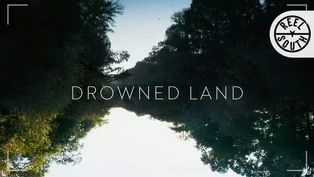
Drowned Land | Official Trailer
Video has Closed Captions
Preview: S11 Ep1103 | 30s | A filmmaker probes dams, displacement, and family legacy. (30s)
Video has Closed Captions
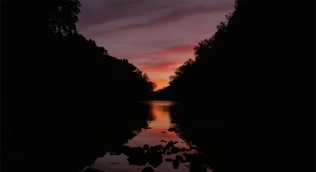
Clip: S11 Ep1103 | 1m 41s | Sandy visits the sacred birthplace of the Kiamichi River. (1m 41s)
Video has Closed Captions
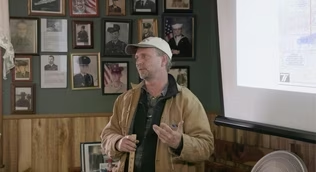
Clip: S11 Ep1103 | 1m 55s | Dr. Ken Roberts warns residents about a hydropower project. (1m 55s)
Providing Support for PBS.org
Learn Moreabout PBS online sponsorship











Support for PBS provided by:
Support for Reel South is made possible by the ETV Endowment of South Carolina, National Endowment for the Arts, and Wyncote Foundation.