
Paquito D'Rivera: From Carne y Frijol to Carnegie Hall
Season 2026 Episode 2 | 55m 35sVideo has Closed Captions
A celebration of the remarkable life, career, and legacy of Latin jazz legend Paquito D’Rivera.
Through music and memories, celebrate the life and legacy of jazz legend Paquito D’Rivera. Trace his journey from child prodigy in Cuba to a stellar career as a multi-GRAMMY Award-winning musician, composer, and beloved Latin jazz ambassador.
Problems playing video? | Closed Captioning Feedback
Problems playing video? | Closed Captioning Feedback
Paquito D'Rivera: From Carne y Frijol to Carnegie Hall
Season 2026 Episode 2 | 55m 35sVideo has Closed Captions
Through music and memories, celebrate the life and legacy of jazz legend Paquito D’Rivera. Trace his journey from child prodigy in Cuba to a stellar career as a multi-GRAMMY Award-winning musician, composer, and beloved Latin jazz ambassador.
Problems playing video? | Closed Captioning Feedback
Where to Watch VOCES
VOCES is available to stream on pbs.org and the PBS app.
Buy Now
Providing Support for PBS.org
Learn Moreabout PBS online sponsorship♪ ♪ [Cheering and applause] ♪ D'Rivera: Jazz is about your own opinion of the music, and the opinion is never wrong, you know why?
Because it's free, you can do whatever you want.
♪ The only thing that can happen is that people don't like it.
OK, they don't pay you, very simple.
♪ D'Rivera: Music, not every day the same story.
It's improvised.
You have certain elements that are being planned, but some days you are more creative than others.
♪ D'Rivera: Some days, you are rockier than others.
♪ Sometimes wonderful things happen, that you say, "Wow, I wish I recorded all this."
That's the way it works.
♪ [Cheering and applause] D'Rivera: My father was a classical saxophone player.
He had a very, very small music business.
He imported music and instruments from Paris and from the United States.
All the musicians were around us.
So for me, music was part of my life.
♪ D'Rivera: I was given my first saxophone when I was 5 years old.
So, I'm talking about 1953.
♪ D'Rivera: Mi mamá era modista.
Ella cosía muy bien.
Me hizo mis primeros trajes de actuación, me los hizo mi mamá.
Todavía estaba por ahí Cab Calloway.
Y Cab siempre usaba unos frac.
Mi mamá me hizo un traje, un frac blanco de cola.
Mi madre estaba feliz de que yo fuera músico.
Ella se casó con un músico.
Ella siempre estaba tratando de cooperar a que yo tuviera una carrera feliz.
En esos días, el jabón más famoso era el jabón Camay.
Y tenía un tema muy bonito, muy corto, y mi padre me enseñó a tocar ese tema.
Eso fue lo primero que yo toqué.
Que es así.
[Playing sax] ♪ D'Rivera: Y salía una muchacha muy bonita enjabonándose así en la ducha.
[Laughs] Y como a mí desde niño siempre me gustaron mucho las muchachas bonitas, pues entonces aprendí a tocar esa... esa melodía.
Mi padre inventó el slogan, ese de "el saxofonista más pequeño del mundo".
Lo digo con mucha propiedad.
Yo no sé cómo sabía eso, pero bueno.
Alguien me puso "el niño prodigio del saxofón", pero a él no le gustaba, él no lo inventó eso, porque el nombre prodigio no le gustaba mucho.
Él decía que prodigio era Mozart, y eso es otra cosa.
[Laughs] La experiencia del primer viaje fuera de Cuba era como un niño ahora ir a Disneyland.
Mi padre consiguió que nos contrataran en la República Dominicana.
Y en esos días, había dictadura en Cuba y en la República Dominicana también.
Era una época de mucha violencia, dicen, en la época de la dictadura de Trujillo.
Y el que dirigía "La Voz Dominicana" era un hermano de Trujillo que le llamaban Petán.
Petán andaba caminando por toda la emisora con una ametralladora Thompson en la mano.
Yo nunca le vi dispararle a nadie con la ametralladora, pero eran unos personajes esa gente, ¿no?
[Applause] Yo tendría 12 años, yo creo.
La mayoría de la gente estaban muy emocionados con el cambio.
Me acuerdo que vimos el discurso desde cerquita de mi casa.
Estábamos frente al televisor que mis padres habían comprado hacía poco en Sears.
Mi mamá se paró y dijo: "Este tipo es peor que el que se fue.
"Vamos a tener que salir huyendo todos de aquí, "ese es peor".
♪ Entonces, me llamaron para el servicio militar.
Eso fue una bomba para mí.
Pero estuve 2 años y 6 meses en el servicio militar, en la banda del Estado Mayor con músicos muy buenos, porque reclutaron a muchos de esos chicos músicos que andaban por ahí regados.
Los agarraron a todos.
Fue una cosa muy triste, porque nadie quería estar 3 años en el ejército.
I met Chucho Valdez playing in a jazz club.
And he was a very young guy, very lanky, tall, black guy, playing the piano in the style of Oscar Peterson.
I said, "That's impossible."
With that age, nobody's supposed to do that.
♪ Paquito D'Rivera.
Chucho Valdez.
♪ D'Rivera: More or less the same group of young musicians used to listen to Willis Conover, "Voice of America Jazz Hour."
Conover: Willis Conover speaking.
This is "The Voice of America Jazz Hour."
The music of jazz parallels the freedom that we have in America, something that not every country has.
D'Rivera: Listening to that, we discovered so many great musicians that we don't have any possibility to see them live.
In those days, they didn't like us to play jazz music, because they called it "imperialistic" music.
The music of the enemy and all that.
Paquito era un teenager.
Yo tendría 23, 22, no sé.
Éramos como si fuera dos niños.
Las maldades que hacíamos nosotros y las cosas que se nos ocurrían son cosas que eso más nunca se nos va a olvidar, porque fue una etapa de ver por primera vez, salir a la luz a ver y a ver a los jazzistas europeos y ver a Dexter Gordon y todas estas cosas.
Vaya, eso lo hemos vivido juntos.
D'Rivera: In Budapest, Hungary, Chucho and I, we went to a banquet that they had for us, We walked to the hotel.
We arrived there like, I don't know, 2:00, 3:00 o'clock in the morning, and we saw all those shoes at the door of the rooms in the hotel.
I said, "Chucho, what is that?"
He said, "The Europeans, they leave the shoes there, "and then there is a guy who cleans the shoes "throughout the night."
"No kidding!"
I said, "What about if we change the shoes "from door to door?"
And Chucho said-- We were very young.
"Door to door?
No.
"Floor to floor."
The following day, we had to leave very early in the morning to another town.
We came down, and there were people saying, "What is this?"
There was a very big guy with a pair of shoes this big.
And of course, everybody in the group knew it was us.
And we were like... [Laughs] We had been working together, Chucho, Carlos Emilio, myself, in different places.
Irakere was like the culmination of all those years of doing different stuff.
Aquí está el sonido Irakere.
En Recital, durante media hora, pasaremos gratos y emotivos momentos en una aventura musical con el grupo cubano de proporción internacional.
♪ D'Rivera: So, Chucho and Oscar Valdes put together this group of dance music.
Valdes: Cuando empezamos a pensar en incorporar a Paquito, decidimos hablar con él y convencerlo.
"Paquito, mira, es bueno que lo hagas".
"Pero yo quiero tocar jazz, yo quiero tocar... "desarrollar el estilo".
"Bueno, vamos a hacer una cosa.
"Tú vas a hacer lo que tú haces, "y nosotros le ponemos los tambores batás, "le ponemos los ararás, "le ponemos los yorubas, le ponemos todo esto.
"Y usted mezcla Charlie Parker con John Coltrane, "contigo mismo, con lo que tú quieras, "y ahí estamos".
Así fue.
♪ Irakere was old wine, new bottles, like the Americans say.
♪ D'Rivera: We knew that we were very good musicians, but never that we were going to be of such great impact in Latin jazz or Latin music.
Mainly, we want to take a plane and go around and meet the world.
Valdes: Paquito contribuyó a Irakere porque en mi opinión ha sido, y es todavía, y será, para mí el más grande intérprete de saxofón, de clarinete, pero no solamente eso, sino como compositor, como creador, ¿no?
Y él fusionaba muy bien todas las corrientes estas de los clásicos.
♪ D'Rivera: I remember when I wrote the adagio based on the second movement of the Mozart Concerto for Clarinet and Orchestra.
Chucho said, "Let's play it tonight at the dance gig."
I said, "No, no, no, don't do that.
"No, no, I just want to know how it works."
"Yeah, let's play it tonight."
It was one of the big successes.
♪ D'Rivera: I think Mozart would like that version.
♪ I met Dizzy Gillespie in 1977 in a very peculiar way.
Everything with Dizzy was peculiar.
[Laughs] I arrived in my house, and there was a paper bag, handwritten.
"Paquito, we have been looking for you.
"¿Dónde estabas?".
And then in Spanish, [Bip].
I said, "What is this?"
"Dizzy Gillespie."
This had to be a joke.
And I went to the corner.
Jesus el bodeguero.
Jesus was there and said, "Did you receive the note?"
I said, "What note?
"What are you talking about?"
He said, "There was a guy here, "a black guy, chubby, "dressed like Sherlock Holmes, "looking for you."
That had to be Dizzy Gillespie.
That's impossible.
And then, like an hour later, I received a visit of the police.
I said, "I didn't do nothing."
They said, "No, no, no.
"There is a group of American musicians here.
"We want you, with the group and Chucho, "to play with them."
That evening, we played a concert.
It was fantastic.
Dizzy was like a mentor for me, like a blessing for me.
♪ D'Rivera: Cuando Franco nació, fue una... es una... una... una sensación inenarrable, ¿no?
Tener un hijo.
Fue una cosa que yo anhelé.
Y él, desde niñito, siempre fue muy artístico.
♪ Y siempre tuvo una atracción tremenda por las artes, inclusive la lectura.
Le gustaba leer desde niño.
Pero Franco siempre tuvo un carácter muy alegre, y era muy creativo, sumamente creativo y chistoso.
Yo hice muchas giras, y la verdad es que siempre lo extrañaba mucho.
Después que pasaba una semana de gira por ahí con Irakere, ya yo empezaba a extrañarlo a él.
El día que yo decidí por fin irme de Cuba fue una experiencia traumática.
No se me va a olvidar nunca.
En esos días habían sucedido los tristes eventos de la Embajada del Perú, donde se metieron 11,000 personas en los terrenos de los jardines de la Embajada del Perú en La Habana.
Después, en dos meses, se fueron 125,000 cubanos por el puerto del Mariel.
Yo me deprimí muchísimo y... "Yo no me voy a morir aquí.
"Ya yo no puedo aguantar más esto."
Y de pronto, nos salió un viaje por Europa.
Y entonces hablé con la madre de mi hijo y le dije: "Hay esto".
Ella me dijo: "Tienes que irte, "tienes que irte, porque esa lengua que tienes tú "aquí no funciona, aquí no se puede hablar.
"Es tan claro como eso.
Aquí no se puede hablar".
♪ Y, bueno, me monté en ese avión que iba para España y después a Suecia.
Estuve 6 horas, esas fueron 6 horas horribles.
Esperé 6 horas en el aeropuerto de Barajas, y me acuerdo que yo dejé mi saxofón debajo de una mesita y cuando me llamaron al vuelo, yo le dije a Chucho precisamente: "Chucho, se me quedó el saxofón allá atrás".
Me acuerdo que Chucho me dijo: "Corre a buscarlo".
Entonces, agarré el saxofón y me fui por otro lado que no era la puerta del avión.
Valdés: A mí me tuvieron que comprar espejuelos oscuros cuando llegué a Estocolmo.
Tenía los ojos rojos.
D'Rivera: Sí, eso me lo contaron.
Valdés: De llorar.
Porque después éramos los Irakere sin Paquito.
Habíamos perdido el espíritu.
Sí, también, todos eran buenos músicos, pero Paquito era el corazón de los Irakere.
Eso lo digo yo.
Yo, que supuestamente era el director, este señor era el corazón de Irakere.
D'Rivera: Yo no sabía eso.
Valdés: Bueno, mejor si no lo sabías.
Era el señor del carisma.
La pregunta típica a un cubano, sobre todo de otro cubano que vino antes, es, "¿Por qué no te fuiste antes?".
Y es que de Cuba uno no se va cuando quiere, sino cuando puede o cuando es la oportunidad que muchos la han perdido.
No es un paso fácil, sobre todo yo tenía una mujer de la que estaba muy enamorado y un hijo con ella.
Es difícil para mí hablar de eso porque yo tuve que dejar ahí a mi hijo Franco, siendo él muy jovencito, de 5 años, y ya no lo vi más hasta que tenía 13.
Traté por todos los medios de sacarlos de ahí.
Hubo momentos terribles, sobre todo cuando me enteré que ya el matrimonio se había destruido, que no... no tenía arreglo eso.
¿Sí?
O sea que yo perdí toda la niñez de mi hijo.
Con unas heridas tremendas, porque al tú perder la niñez de tu hijo, al tú no poder criar un muchacho, ya no es tuyo más.
♪ D'Rivera: Ever since I was a kid, I dreamed of the city of New York.
Always I wanted to live around here and be a musician in the city of New York.
But what is important is that an immigrant is not the same thing as an exile.
As much as you are happy, something is always missing.
You are an orphan.
You don't have a land.
You cannot go back.
Paquito, wow, he took some serious risk and sacrifice to follow his passion, to follow his sanity.
And, uh, you know, you come to the United States and you start from scratch.
♪ Ladies and gentlemen, it's my great pleasure now to introduce Mr.
Paquito D'Rivera.
[Applause] ♪ Working with Dizzy was so much fun.
Great artist and very generous person.
He enjoyed giving all the people the opportunity to shine.
♪ Two of my favorite artists are people with great sense of humor, and they were very serious artists.
One is Wolfgang Amadeus Mozart, and the other one is Dizzy Gillespie.
Both of them totally nuts.
♪ Sometimes I had to tell him, "Dizzy, you have to play a little more.
"People come here to see you."
"No, no, no, you go and do your thing."
He enjoyed your success as much as yourself when you play with him.
[Applause] I am very lucky to be part of the history of that wonderful man.
And that was a friendship that lasted to the last day of his life.
Feliciano: I was producing a record and in came this very well-groomed, young, dapper guy came in.
It was almost like love at first sight.
I didn't know anything about Irakere or him at all.
I really did not grasp at all until much later.
Fue una cosa muy traumática, porque tuve que esperar casi 10 años para reunirme con... con mi hijo.
El encuentro fue tremendo.
Fue, como se esperaba, muy emotivo.
Feliciano: There's a photograph of Paquito embracing his son.
It's heart-wrenching, that photograph, because the emotion of, oh my God, I got you, my son, my son.
D'Rivera: Traté de reconectar con Franco a través de la música.
Él aprendió a tocar el clarinete.
Es un tipo muy talentoso.
Nos invitaron a un programa de televisión a contar nuestra historia.
Man: For 8 years, our next guest tried to obtain the release of his family from Cuba.
He is the famous Cuban-born saxophonist Paquito D'Rivera.
D'Rivera: Brenda me ayudó muchísimo en esa época.
Man: So Brenda, what part did you play in this?
Feliciano: I was able to get a big, nice story in People magazine.
I mean, we went public because before we were doing this very quietly because we were scared they would be put in jail.
D'Rivera: I was sure I was going to see him again, and when I saw him after 8 years, I felt that I saw him last night.
I think a father wants to bring up his son just like the relationship that Paquito had with his father who was so close to him and, you know, guided him through his musical studies and many things that he got from his father, no?
So that kind of relationship was lost, it was broken there.
Man: Can we have a little duet here, Franco and Paquito together?
D'Rivera: Sounds good to me.
♪ D'Rivera: Y esa fue una de las últimas veces que tocamos juntos.
[Applause] Yo no pude criar a mi hijo.
Y, bueno, lo quiero muchísimo, y supongo que él me quiere a mí y todo, pero hay como una zanja que es difícil cruzar.
I remember the day my father came home with an LP of Benny Goodman recorded at Carnegie Hall in 1938.
♪ When he said Carnegie Hall, I understood "carne y frijol".
¿Carne y frijol?
What does that have to do with my mother cooking here?
♪ D'Rivera: Always I feel very thankful when someone gave me an award.
But I don't live for awards.
Some great artists never receive awards.
[Donkey braying] That's my friend the donkey!
[Laughs] That's strong, huh?
Like Pavarotti.
[Laughs] Very good.
I will be there in a minute.
[Donkey braying] ¡Burro!
Qué lindo eres.
♪ Urcola: Paquito is very demanding, he's very serious about the music.
On the other hand, he's very relaxed, you know?
He's very confident of himself, so he can basically play concerts with any kind of musician.
So even though he likes to use the same people all the time, he doesn't need to play with the same people all the time.
Some artists, they need to have that unit, and without that unit, they can't function.
But Paquito can do a concert with anything.
You know, even though it's been almost 30 years, I don't feel like I'm locked.
♪ D'Rivera: That's right.
All we have to do now is learn the notes.
[Laughs] ♪ [Cows mooing] [Cheering and applause] ♪ [Cheering and applause] The most important thing I learned from him and experienced from him is 100% trust.
The train, I say, starts leaving the station, the show starts, and he doesn't look back.
He trusts you.
Ah, mira, la camisa con los carritos.
D'Rivera: Me la regaló Chucho a esta camisa.
Yavnai: Como dicen, bonita tela.
D'Rivera: Sí.
Yavnai: He asked me, "What do you expect?"
I said, "I learned not to expect anything with Paquito.
Whatever comes through."
It's true.
D'Rivera: You never know, but it's part of this art, you know, the art of the improvisation.
It feels very natural because in the art of the duo and in general, in the art of music, it's more important to listen than to play.
Anyway, so you keep your ears very open, and that's it.
You don't have to play all the time, especially when you are improvising.
♪ [Applause] [Laughs] Esto es divertido.
Esto es como hacer el trapecio, es muy divertido hasta que te caes de arriba.
In his classical music playing, you know, he has an incredible sense of... of groove.
And in his compositions, he has elements of both.
And in his jazz playing, he's, you know, he can manipulate tonal qualities that are... So I think if you take all of those elements together and you put them in just an exceptional musical personality, you're going to hear a distinct sound.
♪ [Cheering and applause] ♪ D'Rivera: Nothing like playing for a live audience.
You have to play for the people.
There's nothing like that.
Like having the feedback of what the people feel.
The commentaries, the applause or not.
♪ I don't like the division between the audience and us.
I want to make the audience part of what we are doing.
You know, to feel relaxed.
[Cheering and applause] D'Rivera: Qué es Cuba para mí, me preguntaste, pues.
Mira, yo quería muchísimo a mi abuelo.
Él murió.
Pero si yo regreso y abro la tumba de mi abuelo, ya ese no es él.
Y Cuba es un poco eso.
Ya no es el mismo país.
Yo supongo que debe haber cosas, eh... que se han quedado igual, pero serán muy pocas.
Ahí queda muy poco de... de lo que yo dejé.
que ya no era bueno de por sí.
Es como ir a buscar un edificio que se derrumbó.
Era muy lindo el edificio ese, pero ya no está ahí.
I like old cars.
The car design in those days was really an art.
Now all the cars look the same, you know.
This is my beloved Bel Air '57, exactly like the one that my father and I, we saw in Havana in 1956.
We were walking around, and I asked my father, "[Bleep] papá, cómprate ese carro".
"Are you crazy?
That car cost $1,200."
$1,200!
With that, now you buy the wheel.
♪ Feliciano: So my challenge has been to let all the aspects of the entertainment business know that he belongs in all of them.
In many capacities as a composer, as a performer, as a dancer, as a comedian.
Dancer, too!
We have been together for more than 40 years.
She did a wonderful job.
We're still working together.
Not always is an ideal way to do business, but in our case, it worked perfectly.
For some reason.
I like it.
[Laughing] But that's a partnership.
That's what we have created.
And that's the way we are.
So we're funny, we fight, we argue and all those things, but things come along, you know.
We're still here.
D'Rivera: Yo-Yo is a typical classical trained musician.
He is very open-minded.
So when he decided to do that Brazilian project, they called me.
The Brazilians have adopted Paquito as one of theirs.
You know, we did Chorinhos.
And so, of course, he was like, you know, the perfect person to play Chorinhos.
And we not only made a recording, but then we toured.
Working with Yo-Yo was a lot of fun.
As simple as that.
A lot of fun.
A person that gives you a space to do what you have to say in music.
And I miss him once in a while.
[Laughs] Ma: To tour with Paquito is a lot of laughter, a lot of great stories.
There's so many stories.
Oh, my goodness.
Has he lived life!
♪ The friendships that you make through music, they're strong.
They're really strong and profound relationships.
And I think that... you know, music gives us this gift of connecting with people.
♪ Cohen: When you make music with another person, it's a whole other level of intimacy.
And it's a relationship that if the heart is connected to the other heart, it's forever.
♪ Man: From NPR.
Woman: It's From the Top.
Man: Celebrating the power of music.
Woman: In the hands of America's kids.
[Cheering and applause] My father was a great teacher.
He always said that we learn more from the students than what the students learn from us.
In many occasions, they have questions that we never ask ourselves.
How to do this?
How to do that?
And sometimes you don't know how you do it.
So you better find out how.
♪ I play that.
D'Rivera: You play the part in E. We play that together.
Not in the score, but we can.
D'Rivera: See, this is a little too soon.
[Sings softly] ♪ D'Rivera: I love performing with young musicians.
It's a combination of experience, in my case, and freshness on their side.
Man: Maestro, will you introduce what the two of you are going to play?
D'Rivera: I don't remember what we're going to play, but... We'll play something.
Man: Whenever you two are ready, you can take it from the top.
D'Rivera: All right.
♪ [Cheering and applause] ♪ Ma: Sound is the result of everything about that person.
And what you hear is the tip of the iceberg.
♪ What's at the bottom, the 90% of what you don't see, or what you don't hear immediately in the sound, is the sound itself, is the basis from which the sound emerges.
♪ Getting your own sound is something very hard to do, but not impossible.
It's good to have your own sound, but it's not absolutely necessary.
Some people get tormented with that.
Not every day Charlie Parker is born, or Louis Armstrong, and people can live without it.
But I have my own sound, I don't know how.
♪ I have been so eclectic that I never had... I never had a system of composing.
You know, the inspiration comes always from different places.
It is the narrative of my own life, which has been so eclectic.
Ma: Paquito's relationship to the audience begins before he enters the studio.
You hear often, when I'm backstage, "Hey, what's up?"
You know, you hear his voice.
People are ready to celebrate.
It sets the tone.
D'Rivera: Hola, Chinito.
Ma: El Chinito.
The Chinito's here!
D'Rivera: Chinito!
♪ Chinito Yo ♪ Man: Are you guys ready?
D'Rivera: Are you ready?
Ma: Never!
Go!
D'Rivera: Have fun.
[Applause] D'Rivera: A few years ago, a guy from Kennedy Center called me and said, "You still want to write that Rice and Beans concerto?"
"You remember Yo-Yo Ma?"
"Oh, yeah, yeah, the Puerto Rican cellist."
[Laughing] D'Rivera: Yes.
Ma: Cuban.
D'Rivera: Oh, yeah!
[Applause] D'Rivera: "He said that you threatened him "to write a piece for you and himself "called the Rice and Beans concerto."
The thing is that for some reason I call him Rice, and he calls me Beans.
[Laughing] But in order to give some seriousness to the thing, she suggested me to call it "The Journey."
How's that?
So this is "The Journey" for all of you.
Thank you for coming to see us and to this wonderful orchestra.
[Applause] ♪ [Cheering and applause] Ma: Not only is it a wonderful piece, but the way he plays it, he's just an extraordinary clarinetist, musician, and he was just fabulous.
D'Rivera: And the one and only Yo-Yo Ma on the cello.
[Applause] D'Rivera: Thank you, Rice.
Ma: It's been an amazing journey to be a friend of Paquito's.
De Paquito extrañaba el sentido... una de las cosas, al músico, por supuesto.
Eso está de más.
Y después, el sentido del humor, la alegría que Paquito transmite.
Paquito por donde quiera que pasa, deja una huella, pero una huella muy positiva, ¿no?
Y realmente se extrañó, dejó un bache muy grande en los Irakere.
♪ Valdés: Nosotros siempre trabajamos experimentando en la práctica.
Eso es un trabajo peligroso, pero si tú sabes hacerlo, puedes hacer maravillas con eso.
♪ Valdés: Nunca fui más feliz de estar junto a este señor, porque yo lo adoro, y lo adoré, y lo voy a adorar, y lo voy a querer siempre.
Y lo voy a extrañar, y lo extrañé toda la vida.
Paquito es todo.
Musicalmente, Paquito es muy importante para mí.
Yo he cambiado la forma de tocar porque la inspiración que él me da, esa no me la ha dado nadie en mi vida.
D'Rivera: Bueno, eso a mí me enorgullece.
¿Qué puedo decirte?
Es la continuidad de mi vida.
Mi vida no podía terminar sin... sin el Chucho.
Man: Buenas noches, gracias a todos.
Paquito D'Rivera, Chucho Valdés.
[Cheering and applause] [Cheering and applause] D'Rivera: Nosotros estamos tan felices de estar acá.
Yo pienso... Valdés: Escuchando una obra que compuse, que se llama Chorinho, una obra que compuse hace tiempo, escuché una versión de ese Chorinho escrita por Paquito para 4 clarinetes.
La emoción fue tan enorme que sentí, que le pasé un mensaje diciéndole: "Oye, Paq-Man, "yo todavía te extraño".
De aquí sale un tema que Paquito puede explicar ahora.
D'Rivera: Bueno, pues yo soy el que voy a escribir una pieza que ya casi está terminada que se llama "I Miss You Too."
Yo también te extrañé, Chucho.
Y esa pieza, el título, y lo voy a decir en inglés también para que el que no lo hable que lo entienda aquí.
That is the title of our new CD that you should get it as soon as you get out of this theatre.
[Laughing] D'Rivera: I missed you too, Chucho.
♪ [Cheering and applause] D'Rivera: Estamos de regreso, Chucho y yo.
[Cheering and applause] Well, well, well, here I am in Carnegie Hall.
They invited me to do a podcast with the--playing the clarinet of Benny Goodman.
So Benny was one of my first heroes.
So... Carnegie Hall, Benny Goodman, that's a good combination.
♪ I'd never think I was going to be playing Benny's horn.
♪ Qué bueno está el instrumento este.
♪ Wow.
♪ Mi padre aprendió a tocar el clarinete, y yo no sé cómo, para enseñarme a mí a tocarlo.
Y su ídolo también era Benny Goodman.
Así que si yo le hubiera dicho que iba, 70 años después, a estar tocando el clarinete de Benny en Carnegie Hall, no lo hubiera creído, no.
♪ Can I keep it?
[Laughing] ♪
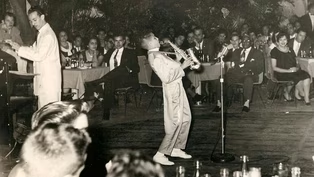 New
NewPaquito D’Rivera Child Prodigy
Video has Closed Captions
Clip: S2026 Ep2 | 2m 59s | Paquito reminisces on his childhood beginnings in music. (2m 59s)
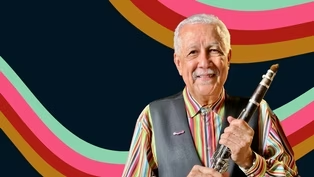
“Paquito D'Rivera: From Carne y Frijol to Carnegie Hall” Trailer
Video has Closed Captions
Preview: S2026 Ep2 | 30s | A celebration of the remarkable life, career, and legacy of Latin jazz legend Paquito D’Rivera. (30s)
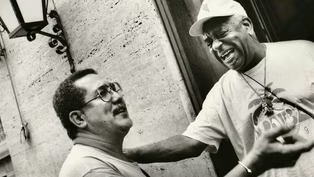 New
NewPaquito D’Rivera Meets Dizzy Gillespie
Video has Closed Captions
Clip: S2026 Ep2 | 2m 9s | In 1977, Dizzy Gillespie visited Havana and met Paquito for the first time. (2m 9s)
Providing Support for PBS.org
Learn Moreabout PBS online sponsorship












Support for PBS provided by: