Prairie Yard & Garden
Pollinator Pathways
Season 39 Episode 1 | 28m 45sVideo has Closed Captions
Rhyan Schicker and her team advocate for monarchs and vital pollinators by leading a movement.
Rhyan Schicker and her team advocate for monarchs and vital pollinators by leading a movement to strategically plant native gardens in the Dawson and Boyd areas. Their collective work in private and public spaces creates stunning, healthy habitats essential for these species.
Problems playing video? | Closed Captioning Feedback
Problems playing video? | Closed Captioning Feedback
Prairie Yard & Garden is a local public television program presented by Pioneer PBS
Production sponsorship is provided by Shalom Hill Farm, Heartland Motor Company, North Dakota State University, Friends of Prairie Yard & Garden, and viewers like you.
Support provided by:


Prairie Yard & Garden
Pollinator Pathways
Season 39 Episode 1 | 28m 45sVideo has Closed Captions
Rhyan Schicker and her team advocate for monarchs and vital pollinators by leading a movement to strategically plant native gardens in the Dawson and Boyd areas. Their collective work in private and public spaces creates stunning, healthy habitats essential for these species.
Problems playing video? | Closed Captioning Feedback
How to Watch Prairie Yard & Garden
Prairie Yard & Garden is available to stream on pbs.org and the free PBS App, available on iPhone, Apple TV, Android TV, Android smartphones, Amazon Fire TV, Amazon Fire Tablet, Roku, Samsung Smart TV, and Vizio.
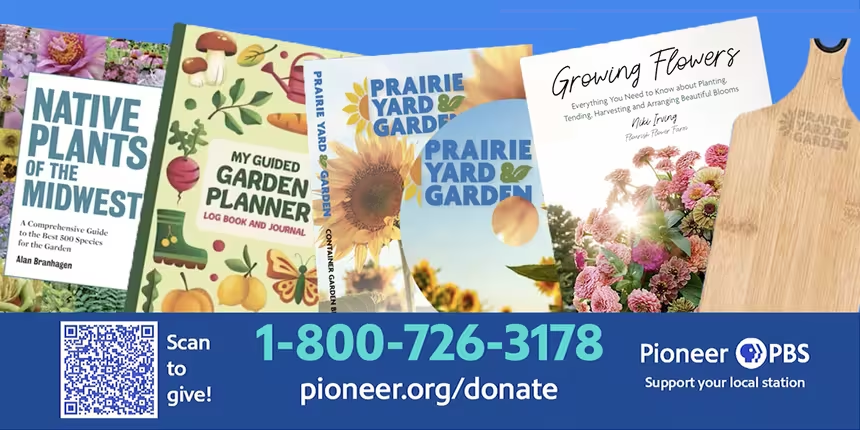
Prairie Yard & Garden Premium Gifts
Do you love gardening? Consider becoming a friend of Prairie Yard & Garden to support this show and receive gifts with your contribution. Visit the link below to do so or visit pioneer.org/donate.Providing Support for PBS.org
Learn Moreabout PBS online sponsorship- Everyone who watches our show knows how much I love plants, flowers, butterflies, and pollinators.
Our friend, Tracy Hansen, was telling me about this huge planting project being started in her town.
Well, I was all ears and wanted to find out more.
I'm Mary Holm, host of "Prairie Yard and Garden," and let's all go to Dawson, Minnesota to find out about the details of what this pollinator project is all about.
- [Narrator] Funding for "Prairie Yard and Garden" is provided by Heartland Motor Company, providing service to Minnesota and the Dakotas for over 30 years in the heart of truck country.
Heartland Motor Company.
We have your best interest at heart.
Mark and Margaret Yeakel Jolene in honor of Shalom Hill Farm, a nonprofit rural education retreat center in a beautiful prairie setting near Windom, Minnesota.
And by Friends of "Prairie Yard and Garden," a community of supporters like you who engage in the long-term growth of the series.
To become a friend of "Prairie Yard and Garden," visit pioneer.org/pyg.
- During the many years I worked at the Native Plant Nursery, it was my pleasure to meet lots of homeowners as well as professionals that were doing native plantings for pollinators.
One of the people I visited with via email and phone was Rhyan Schicker.
Well, it was so exciting to me to find out that we would finally get to meet in person, as she is in charge of doing the big plantings in Dawson.
Thanks so much, Rhyan, for letting us come to learn about your project.
- Thanks so much for having me.
I'm so excited to talk about native plants with you.
- What is your background?
- Yeah, my background is I have been a district manager at Lac Qui Parle Soil and Water for a little over two years now.
Before that, I was a technician for about five, have been working in the environmental field for about 10 years or so.
- What is the work that you do now?
- I wear a lot of hats.
We do a lot of conservation planning with local farmers.
We work with residents on invasive species removal.
We do a lot of plantings of native plants.
After the past few years, that's become a lot more popular.
And then a lot of different types of environmental education throughout the county.
- How did you get started with planting for pollinators?
- Oh, man.
I think some of it started as a personal hobby, and then the Lawns to Legumes program that is a State of Minnesota program for residents to install pollinator habitats at their own homes kind of kicked that off.
We had a lot of residents who participated in the program and they needed some guidance.
So, I signed up to be a coach and that kind of started getting me into working with residents on designing plantings for native plants.
- So, now what is the Pollinator Pathways Project?
- Yeah, the Pollinator Pathways Project is kind of a larger-scale version of the Lawns to Legumes.
Lawns to Legumes is just for one resident to apply and they can be reimbursed up to a certain amount for their property, where Pollinator Pathways kind of encompasses an entire community, so that way we can work on private property as well as city-owned property so that everybody kind of has an opportunity to enjoy these plantings, whether they have their own space or not.
So, we kind of came up with a bunch of projects that we had and then bundled them all into one package and applied for it for the City of Dawson.
It works very similar to Lawns to Legumes, but it's more of like a parent program to it, like a larger encompassing project.
- Then, how does a community get started in doing a project like this?
- Yeah, so we had a kickoff event where we invited residents to come in and learn about the project and what they could do to take part in it, talked to them about different parts of their yard, you know, what the plantings include.
You can do seeds, you can do live plugs, you can do pollinator-beneficial trees and shrubs.
So, we would get a little bit of information from them.
And then I've been doing a lot of house visits kind of going over and walking around with residents to see, like, this would be a good area, this area might not be the best, kind of pairing what they're looking for with what the program can offer.
- [Mary] How do you select the sites that you work on?
- [Rhyan] So, some of the sites that are public property, we found areas that maybe the city doesn't wanna mow anymore that would be nice to kind of put native plants there and provide some interest as well as stop having to maintain so often.
Other sites are parks, places where people already are going so that we can just add a little extra beauty.
Areas along the river are great corridors for pollinators.
So, we tried to pick a couple of those as well.
And then also just residents or organizations coming to our office and kind of saying, do you have a program for something like this?
So, it's been a little bit of both having the public come to us that's interested and a bit of choosing locations we really wanted to put some pollinator plantings together.
We are trying to pull in as much the public as possible to help with the plantings, in hopes that they'll be a community that wants to help maintain these past the grant period.
The grant kind of requires that planting stay in place for five years.
Of course, we'd like to see it go much beyond that.
So, our hopes that are through educating and pulling in the community to feel like they're really a part of this, we'll kind of build a movement where people are appreciating the plants and wanting to keep planting more of them in the future.
- Now, what plants do you use for the plantings?
- Each site has a different composition of plantings.
One of the things we wanna do with this is just really increase the diversity of native plants around the city.
You see a lot of the same plants used in landscaping a lot.
So, based on the site's sunlight and moisture availability, we will kind of custom-make a planting for that site.
There's a lot of plants that we will carry throughout different locations, but we try to use as many plants as possible.
We do a mix of flowers and grasses, just for better structure and composition, but we really try to mix it up so that each bloom period is represented.
So, you've got something blooming early in the spring, early summer, late summer, and then into the fall.
So, that way, on top of just looking really nice, you've got food for pollinators all year round.
- Why are native plants so important to use?
- I think that native plants are important for so many different reasons.
Of course, there's the whole food web, the ecological, you know, you need all of these insects to support the bugs, to support the birds, that support the wildlife all throughout.
But then also, being a farming community, our crops really need pollinators.
I think they say it's one in three bites of food we eat is thanks to a pollinator species.
Even things we don't think, like we've got an alfalfa field behind us, it can sustain itself on its own, but when it gets that alfalfa leafcutter bee, it has higher yields.
So, when you just kind of think about letting nature do some work to help us in our farming systems, it's just really important to make sure we have those species, and in a farming community, I think it's even more important to be able to tie those points together.
- Well, can we please find out more about the plants that you use?
- Yeah, I would love to show the plants.
We've got a bunch of them here today.
Some are in the ground, and some are getting ready to get planted.
- Fall is one of my favorite seasons.
The air becomes crisp, all the beautiful colors show up in nature, and you can use those colors to guide your choices on your plate as well.
Just as the greens and leaves fade to reveal reds, oranges, and golds, those same colors appear in vegetables like pumpkins and winter squash.
These vibrant colors come from pigments called carotinoids, especially betacarotene, which our bodies convert to vitamin A. That's the nutrient that helps keep our skin and vision healthy and it also plays a big role in supporting our immune system.
All pumpkins are technically squash, but not all squash are pumpkins.
The squash family includes butternut, acorn, buttercup, spaghetti squash, and many others.
Buttercup squash even has a Midwest connection.
It was introduced in the 1930s by a horticulture researcher at North Dakota State University.
The rich orange flesh of squash isn't just beautiful, it's delicious and versatile.
You can roast cubes of squash with olive oil and herbs, blend cooked squash into creamy soups, or bake halves in the oven with a sprinkle of cinnamon.
Spaghetti squash can also be an alternative to pasta for a lighter meal.
Just as the leaves turn color, consider that as a cue for adding more color to your plate.
Many of us shortchange ourselves on dark orange and dark green vegetables.
I'm Dr.
Julie, bringing the Field to your Fork.
Until next time.
- So, I've got a collection of different plants here that we are gonna be using for this location specifically.
One of the things I wanted to show you was we've got these kits that one of the native plant nurseries we work with puts together.
It makes it kind of really easy for residents to be able to choose without being overwhelmed.
Since there's so many different types of native plants, they can kind of pick one based on what they're looking for at their house.
I can pick one of these kits based on what I'm looking for for a site that we're gonna plant.
So, for this specific site, I brought some Short & Tidy kits because they have a lot of plants that stay about three feet or shorter.
That way it gives it a more pulled-together look.
So, some of the things we've gotten here is prairie smoke, which is just a really nice, early blooming species.
I think one of the things I see a lot is those early blooming species aren't a part of plantings very often.
When we've got a big seed mix out somewhere, they're kind of lacking.
So, I wanted to make sure that when we were doing these plantings, it very deliberately had those types of plants.
There's about 15 or so different kits that come, and then you can make a custom kit as well.
So, we've got Shade kits, Tall Grass Prairie, Short Grass Prairie, Short & Tidy.
It's also really good for boulevards.
We planted the boulevards here in Dawson last week.
So, we used a lot of the Short & Tidy plants.
There's a Monarch Special kit.
There's even a kit that you can use in areas where you've been trying to manage buckthorn, just some aggressive species with long root systems that do good in those parts on shade so they can give a little bit of competition when you're trying to manage the buckthorn.
This is part of a community habitat program that we have with Minnesota Native Landscapes that allows us to get a lot of kits, and get them out to the public through this project for a very affordable price.
And with the grant, we cost share that.
So, it's made a huge difference on being able to get these on the landscape.
- Rhyan, how do you know how many plants to put in a space?
- For the most part, the best rule of thumb that I've come across is about 15 to 18 inches.
It's hard because when you first start planting, there are these little plugs, and you see all this space and you wanna start filling it, but you've just gotta trust it and have some patience because, since they're perennial, every year they kind of establish themselves better.
So, it really is good to leave a little more space than you think you should.
Some of the plants that are larger, the big bunched grasses, you could do as far as two feet apart.
So, usually we'll look at the site that somebody has, kind of get the square footage and then go backwards from that to see how many plants to fill in.
- How do you prepare the site?
- Each site's gonna be a little bit different, but the biggest thing is that you want to make sure you're managing what's there already so that when your new plants are in, they're not getting over-competed.
So, getting rid of the current cover or suppressing it.
We use a lot of weed suppressant matting to plant straight into, should be good for a couple of seasons so it keeps that grass underneath it.
You can do tillage if you're on a larger area.
If you've got a smaller area, you kind of want to remove the grass or weeds about two times as big as the native plant is so it doesn't have a competition right around it.
And then put something over it unless you wanna be kind of weeding it a lot.
Mulch is nice, or some type of suppressant matting is helpful.
- [Mary] How about, then, the watering and the maintenance?
- [Rhyan] Yeah, the first year is the biggest year you really have to worry about with the maintenance.
Since they're little and they're not fully established yet, they do want about an inch of rain per week, whether that's through the watering can or from the sky.
After that, they're pretty drought tolerant.
I mean, each plant is gonna have its moisture regime that it needs.
You've got plants that need something more wet, they're gonna go on a lower area, or in wetter soils.
Or you've got plants that are drier and they like rocky areas, but for the most part they can handle drought.
Minnesota goes through a lot of different weather patterns.
So, since they're native to Minnesota, they're pretty adapted to dealing with some dry, no-rain spells.
- Then, do you use additional mulch on top of the mat?
- Yes.
You can do it multiple ways.
That's where a lot of it is kind of up to what you want it to look like.
If it's somewhere that is getting a lot of traffic and you want it to look a little bit more pulled together, I recommend putting the mulch on top of the matting.
If you're putting it out in the backyard and you just want it to grow and you're not too worried about people passing by seeing it and thinking it looks a little unclean, you can leave it that way, too.
- [Mary] Do you have to come back and do a replant sometimes if you lose a plant here and there?
- [Rhyan] Yeah, with any new planting, there's always gonna be a couple that don't make it.
One of the nice things about having this program is that we've got plants all the time.
So, if I go back to a site and I see a certain species didn't do good, we could switch it out for a different one.
That's one of the nice things about this project is it's a lot of real-time learning.
So, sometimes a plant sounds like it might do good in a certain area and it just doesn't, so we'll just switch it out for something else.
- On the private property, what is the homeowner's responsibility after you're done planting?
- So, for this grant project, you have to keep your planting for five years.
So the homeowner's responsibility is trying to keep weeds out, making sure they're watered, basically keeping the plants alive and in place for those five years, and of course, hopefully longer, hopefully adding on.
But really all it is is just, if we're gonna do this project, keep it in place for five years.
- [Mary] What do you have to do in the fall and over winter to overwinter these plants?
- [Rhyan] In the fall, I know that we're very accustomed to kind of clipping everything down, but with the native plants being pollinator-beneficial species, we really wanna leave them there because a lot of pollinators will overwinter in the stems, or in the base of like a clump grass.
So, you can cut them down a little bit, but mostly you wanna leave everything standing.
That is the best way, is, the more you can leave, the better it is.
And then throughout the winter, you might be surprised, a lot of these plants have pretty neat seed heads.
So, they give some winter interest.
They look nice with the snow on them.
They look nice all together with different types of textures and shapes, kind of a new way to appreciate the garden.
And then in the spring, once you start to see grass growing, dandelions blooming, that's kind of when it's okay to start trimming those back.
- [Mary] These plants are so tiny.
How long does it take for them to mature and and look nice?
- [Rhyan] It can vary from plant to plant.
Some are more eager to bloom, where some need about a year in there before they will give a flower.
But for the most part, the first year after planting, they're gonna look really nice.
One of the nice things about working with the plugs is when you're using seeds, you're waiting years to even get the plug to come up.
So, it's nice being able to start it this way.
It gives it a head start.
Within the first growing season after, you're gonna have a pretty good, established planting.
- [Mary] Can we see an established planting, too?
- [Rhyan] Yeah, we actually finished a project here last May of 2024 in the neighboring town of Boyd.
So, we could go over there and kind of see what a completed planting looks like with all of these in full bloom.
- I have a question.
When is the best time to plant a tree in the late summer or the early fall?
- The best way to plant a tree in late summer, early fall, is to make sure that you do not bury it too deeply or too shallowly.
And what that means is you wanna make sure that you bury it to the same depth that it came in the pot that you purchased it in, or you need to look for the root flare.
And the root flares come out at the base and you'll actually see them kind of like a little triangle shape.
So, we wanna make sure those aren't buried.
The next thing you wanna do is make sure that your hole is dug out twice the width of that root ball.
So, if you look at the container you bought your tree in, you want to dig it twice as wide, but not twice as deep.
Once the tree is level, you wanna make sure that you use the 3-3-3 method for mulching, which means you need three inches deep of mulch, a three foot radius away from the trunk, and most importantly, make sure that there's no mulch within three inches of your trunk.
You don't wanna bury those root flares that I was just talking about.
Once you're done mulching, you need to make sure you're watering your tree, and well, and doing it every few days when you just plant a tree.
You wanna keep watering your newly planted trees for at least three to five years regularly.
Do not count that little spritz of rain as sufficient water.
We want to give them an inch of water every single week.
So, if you're planting a tree late summer and into fall, make sure you have proper aftercare so you have a healthy tree for years to come.
- [Narrator] Ask the Arboretum Experts has been brought to you by the Minnesota Landscape Arboretum in Chaska, dedicated to welcoming, informing, and inspiring all through outstanding displays, protected natural areas, horticultural research and education.
- So, these are our Boyd Legacy Gardens.
These were done as a project through the Board of Water and Soil Resource's demonstration neighborhood gardens.
The idea here is so that residents can kind of get to see firsthand what native plants look like.
- [Mary] Why was this location chosen?
- [Rhyan] We chose this location because it's a public location, so that way if you're a resident who doesn't maybe have the space or ability to plant native plants at your own house, you could come down here and still enjoy them aesthetically and kind of get to know the different species that we would put in a native planting.
- [Mary] How long ago was this planted?
- [Rhyan] So, this grant wrapped up in 2004 of May, so we're about one year into full establishment.
We worked on it piecemeal over about two years.
- So, the plants that we saw you planting earlier in the segment will be this big in about a year?
- Yes.
Of course, weather conditions always play a part.
But yeah, this is just one year of a new planting, and everything is already this big and filled in.
So, we wanted to make sure that we incorporated grasses as well as flowers just because they have good structure and for pollinator benefits, they have good nesting and overwintering habitat.
They kind of help some of our plants stand up a little bit more straight too if they've got something tall alongside them.
We used mostly flowers, but we did try to make sure we incorporated some.
It's probably 85/15% mixes of flowers to grasses.
- So, what is the maintenance required for an area like this?
- The maintenance is a little more than people might think.
I think we like to give native plants a lot of credit for being low-maintenance, which I think they are once you establish them.
But the first couple years are gonna require some maintenance.
What we've seen specifically with this garden here is we've had some thistles and some brome encroachment from some of the surrounding land.
We come out in the spring and try to take care of that.
It's been very rainy this year in this part of the state so there's been multiple attempts at getting rid of the thistles, and once we remove some of those, we put more native plants back in to compete and hopefully keep that weed pressure down in the future.
We've also used mulch to kind of keep the new weed germination from taking over and that's kind of been a good process, too.
- [Mary] What are the maintenance requirements in the spring of the year?
- [Rhyan] So, kind of what we advise is to just leave everything as it is in the fall and winter.
The taller the better, the more wild the better.
And then in the spring, what we're looking to do is kind of cut back that tall growth.
This is probably one from last year still, but for the most part we try to come back late spring after plants have started growing and clip those back so that we know that the pollinators are no longer using them for housing.
Weeding, hand weeding after a good rain, is helpful if you've got something that you need to pull out.
But as far as standing stems of natives, we just use clippers and clip them off.
They're pretty easy.
Or just kind of break them off with our hands because they break pretty easily.
- I've heard that you should try to burn a native area also.
How do you feel about that?
- Yeah, in residential areas, that gets a little bit harder.
So, what we recommend in that way, then, is kind of just mowing down and removing all the standing stems so that it's not too thick of a thatch layer on the ground so that any seed that seeds out from a plant still has a chance to germinate in the future.
So while we might not be able to burn in a residential area, we try to mimic that process the best we can by taking off any of that stuff that would prevent new flowers from germinating or new grasses.
- If the seeds fall to the ground, will they die over the coldness from the winter?
- They won't.
They will kind of lay and wait until the conditions are right for them to germinate.
And a lot of our prairie plants actually require a winter season to break their dormancy.
So, we call that a moist cold stratification process.
So, some plants might need 60 days of that.
Some need 90.
We've even got some plants that need a warm season followed by a cool season, followed by another warm season, followed by another cool season.
So, that's kind of one of the benefits of being able to plant live plugs right away is you're not waiting as long for those mechanisms to unlock the dormancy.
- I see what I think are a lot of beautiful plants out here.
Can you tell us maybe what just a few of your favorites are that are growing here?
- Yeah, yeah.
I really enjoy hyssop, fragrant giant hyssop.
It seems that no matter what time you're looking at it, as long as there is some blooms on there, there's just gonna be tons and tons of bees.
You can stand there and listen to them buzzing.
Butterflies love it.
It smells really good, it has a licorice smell, and it's a very pretty, purple-ish silver color.
I think that's probably one of my favorites.
It also has a pretty extended bloom season, so you're not just gonna get it for a week or two and then it's done.
It lasts for a while.
So, that's probably my top favorite.
If we're talking about grasses, I really love Indian grass.
It has very beautiful bluish-green leaves and the seed head on it.
It reminds me of the amber fall colors, a little bit starting in the summer and then fading into the fall, too.
Just very pretty in a planting.
- [Mary] I have seen monarchs flitting around here.
Do we have some plants here that are some of their favorites, too?
- [Rhyan] Yeah, one that's in bloom right now that they particularly like are the different liatris species, all the blazing stars.
As I look out at the gardens, I can actually see them feeding on it right now.
So, that's kind of nice this time of year especially.
You can have one tall plant with a bunch of blooms on it and sometimes you'll get four to five, up to then monarchs using the same one together.
It's really nice to see that they're enjoying the planting.
- Are there some things that you have learned in doing this planting?
- Definitely.
I would say some of the biggest learning experiences for me is to do the best site prep you can do upfront.
If you try to cut corners or maybe you're not as knowledgeable of what you're planting into, what the site history is, you might have more weeds in the future.
One thing specifically we ran into here was since this area was just conventionally mowed prior, we might not have seen some of the weeds that were there, or what was in the seed bank, but once we kind of dug it up and started planting, we ran into a lot of bindweed, which can be an issue.
So, I think just being prepared for that and knowing that even if they're lower-maintenance plants, there's still gonna be a requirement to do some maintenance, especially up front when it's first getting established.
- [Mary] We are getting towards the end of our regular growing season, and there's still such beautiful color out here.
- [Rhyan] Yeah, that's another one of the things we try to think about when we're designing these gardens, is you want them to look good all year.
So just the same way we think about putting in early blooming species and late blooming species, we're also trying to think about when things stop growing, how can we still provide beauty?
I think a really good example of a plant that provides nice fall color would be little blue stem.
After it's done kind of seeding out, it holds a couple of those fuzzy seed heads on it, and it has a really nice red, blue, green color.
It just pulls the eye to it, even if there's not a flower on it.
- Thanks so much for letting us see how these plants can grow.
- Yeah, thank you.
It's a very fun project.
And I'm happy to share it with people.
- [Narrator] Funding for "Prairie Yard and Garden" is provided by Heartland Motor Company.
Providing service to Minnesota and the Dakotas for over 30 years in the heart of truck country.
Heartland Motor Company.
We have your best interest at heart.
Mark and Margaret Yeakel Jolene in honor of Shalom Hill Farm, a nonprofit, rural education retreat center in a beautiful prairie setting near Windom, Minnesota.
And by Friends of "Prairie Yard and Garden," a community of supporters like you who engage in the long-term growth of the series.
To become a friend of "Prairie Yard and Garden," visit pioneer.org/pyg.
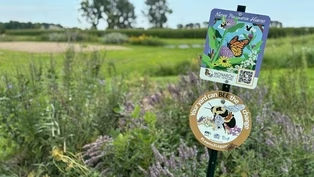
Preview: S39 Ep1 | 30s | Ryhan Schicker discusses the Pollinator Pathways project and native plants with host Mary Holm. (30s)
Providing Support for PBS.org
Learn Moreabout PBS online sponsorship

- Home and How To

Hit the road in a classic car for a tour through Great Britain with two antiques experts.












Support for PBS provided by:
Prairie Yard & Garden is a local public television program presented by Pioneer PBS
Production sponsorship is provided by Shalom Hill Farm, Heartland Motor Company, North Dakota State University, Friends of Prairie Yard & Garden, and viewers like you.