
True North: Canadian Myths and Black Power
Season 27 Episode 14 | 1h 26m 4sVideo has Audio Description
How 1960s Montreal helped shape the global movement for Black liberation.
Through rare archival footage and firsthand accounts, True North revisits 1968 Montreal, where Black liberation movements converged at the Congress of Black Writers. As student protests ignited the Sir George Williams Affair, Black youth faced violent repression, unfolding a powerful chapter of the global Black Power era.
See all videos with Audio DescriptionADProblems playing video? | Closed Captioning Feedback
Problems playing video? | Closed Captioning Feedback
True North: Canadian Myths and Black Power
Season 27 Episode 14 | 1h 26m 4sVideo has Audio Description
Through rare archival footage and firsthand accounts, True North revisits 1968 Montreal, where Black liberation movements converged at the Congress of Black Writers. As student protests ignited the Sir George Williams Affair, Black youth faced violent repression, unfolding a powerful chapter of the global Black Power era.
See all videos with Audio DescriptionADProblems playing video? | Closed Captioning Feedback
Where to Watch Independent Lens
Independent Lens is available to stream on pbs.org and the PBS app.

Aesthetics and Unraveling the AI Hype
Ghost in the Machine seeks to unravel the AI hype to find the untold origins of “artificial intelligence.”Providing Support for PBS.org
Learn Moreabout PBS online sponsorshipPart of These Collections
Providing Support for PBS.org
Learn Moreabout PBS online sponsorship♪ Is Canada a racist country?
A native of Dominica says that it is.
He's Roosevelt Douglas, otherwise known as Rosie Douglas.
Mr.
Douglas, why are you so involved with Canada and the problem of colored people here?
Rosie: Well, first of all, I am a Black man and if there are Black people here, I am going to be involved in fighting with Black people.
Further, having been born in the Caribbean, an area where the Canadian people are exploiting in the most vicious and blatant form, it is my responsibility while I'm here to expose this type of exploitation.
Host: Does that include violence?
Rosie: Well, I mean, if you are racist, by implication you are imposing your-- your--your values and you're imposing your power on people in a manner which is not in the best keeping with their basic human integrity.
And this is a form of violence.
In other words, when you have Black people living in Preston, Nova Scotia, in houses that are not heated, when temperatures drop 20 below zero during winter, this is a form of violence.
This is what we are fighting against!
Black people-- Rosie: We, you-- you are the ones that brought us out of Africa, we didn't ask you to be brought out of Africa!
Host: Are you saying that Black people were brought to this country as slaves?
James McGill, the founder of McGill University, himself owned 12 slaves.
Slaves were also brought from Sierra Leone, 5,000 of them, to build a citadel in Nova Scotia.
So don't tell me that Black people didn't come here as slaves.
The Black people were brought here as slaves.
I didn't say that.
Learn your history.
Host: The majority of Black people... [music] [traditional Haitian folk music] ♪ [music] Singer: ♪ I'm going to feast at the welcome table ♪ ♪ I'm going to feast at the welcome table ♪ ♪ One of these days ♪ ♪ Hallelujah!
♪ ♪ I'm going to feast at the welcome table ♪ ♪ Going to feast at the welcome table ♪ ♪ One of these days ♪ ♪ I'm going to tell God about my troubles ♪ ♪ I'm going to tell God about my troubles one of these days ♪ ♪ Hallelujah!
♪ ♪ I'm going to tell God about my troubles ♪ ♪ Going to tell God all of my troubles one of these days ♪ [woman's laughter echoes, baby's squeals echo] [waves lapping] [waves crashing] [ethereal music] ♪ ♪ ♪ [birds calling, bell clanging] [car horns honking] [vehicle horns honking, indistinct chatter] [music] [music continues] [train bell clanging] [children squealing] Norman: Where I grew up in Toronto was a very diverse community.
It was a happy place generally, and that wasn't just in my little mind.
We used to dance together all the time.
And we had danced together in each other's community centers.
[up-tempo music] ["Sticks And Stones" by Jackie Shane] ♪ People talkin', tryin' to break us up ♪ ♪ Why can't they let us be ♪ ♪ Sticks and stones may break my bones ♪ ♪ But, now, talk don't bother me ♪ ♪ People talkin', tryin' to break us up ♪ ♪ When they know that I love you so ♪ ♪ Now I don't care what the people may say ♪ ♪ I'll never, never let you go ♪ ♪ I've been abused ♪ ♪ Deep down in my heart... ♪ Norman: Kids of European descent would come to our Home Service Association.
We would go to the Jewish YMHA and the Ukrainian Hall, and we'd just pile into these dances.
[up-tempo music continues] This was an era of doo-wop, and an era of R&B, and we all loved it.
[up-tempo music continues] [music echoes, fades] Norman: I had a very close friend who was White.
I recall him saying to me one day when we were going to do something together, I said, "Okay, I'll come over to your house and, you know, "pick you up and we'll..." He said, "Well you can't come."
I said, "Why?"
He said, "We have some American relatives coming "and staying with us and they don't like Black people.
"Don't come, please."
He could never be my friend again after that.
That was it.
We went our separate ways.
[wind blowing] [piano music] ♪ ♪ Our home and native land!
♪ ♪ True patriot love ♪ ♪ In all thy sons command ♪ [piano music] Train announcer: Ladies and gentlemen, we'll be arriving in Montreal, our final visitation, in a few minutes.
For your safety, we ask that you remain seated until the train comes to a complete stop at the terminal.
♪ God keep our land ♪ [train whistle blares] [people speaking French] [double bass playing jazz music] ♪ [whistle blowing] [Haitian folk music, waves lapping] ♪ ♪ ♪ ["Soleil" by Emerante de Pradines] [singing in Haitian Creole] ♪ ♪ [woman speaking French] [gentle music] ♪ Archival film narrator: In our fight against illiteracy, we are helped by international organizations and assisted by several hundred nuns and brothers from French Canada.
[children singing indistinctly] [bell tolling, children chattering] ♪ ♪ [music] ♪ [sirens] [dissonant music] [siren] [music continues] ♪ Philippe: I was raised in a military family, and it was quite understood by everybody that there was one ultimate commander: Duvalier.
And he will shoot you and torture you.
[jazz music] Philippe: There would be whole families wiped out.
Some of the friends that went to school with me, they disappeared.
When I was about 16... my father was working in the telephone company there.
When Duvalier wanted to talk to his ambassador in Italy or something, he would take my father in the middle of the night.
And one time Duvalier told my dad, "Look, "if there is anything that I said that comes out, "you know what will happen to you, my friend."
[siren] So, each time the army truck would come at night, you don't know if they come here to arrest you or to just make a phone call.
My family had to go into exile... so we went to America.
But I was drafted into the army to go and fight in Vietnam.
So if America was attacked, it would be our duty to defend America.
And as much as I was tempted, I felt that, well, it would be a betrayal.
Like, they did the same thing to us and we gonna go and do, do the same to, to these people.
[guitar music] ♪ Border guard: Where do you live?
Man: We live in Massachusetts.
Sharon, Mass.
Border guard: Yes.
The name, please?
Philippe: When I came to the Canadian border, I told the officer that Canada was freedom and I didn't want to fight in the U.S.
Army.
So he look at me and he said, "Look, "I went and fought in Korea."
"I lost my left leg there.
"So you come and tell me "that you not doing your part in the war "for freedom in the world?
"You go back to, to where you came from in the U.S."
And there was this guy waiting on me, this big, huge guy, and suddenly he said, "Listen, young man, "I know how you feel.
"My son was killed in this damn war in Vietnam.
"You stay here and next boss that comes, "tell them that you are going to go skiing."
[rock music] ♪ ♪ [vehicle horn honking] [ethereal music] ♪ [wind howling] [bell ringing] [praying in Latin] No.
[choir singing indistinctly] ♪ ♪ [wind gusting] [singing continues] [waves crashing] [stringed instruments playing jazz music] ♪ ♪ ["A Saint-Henri" by Raymond Lévesque] [Lévesque singing in French] ♪ Brenda: I was born in Montreal... and we were the only Black family that lived on the street.
Both of my parents were from Trinidad and Tobago.
They were very, very strict parents.
You know, when an immigrant comes, they don't come to have a party.
They come for a better life, and they mean it.
[guitar and wind instrument music] My father had experienced so much discrimination in Canada that he made us very aware of the fact that we had to be better.
"They're gonna hold this against you.
You must be better."
And of course, we were kids so we're like, well, that doesn't make any sense!
[laughs] [bell ringing] Brenda: I went to a Catholic school.
There was something called Ascension Day.
When you got your grades, they rated you.
They would say whoever comes first next month will lead the parade.
I came first, and yet they put me in the back.
And I complained.
I'm like, "Why am I back here?
"I'm supposed to lead the parade, I came first."
"Well, you're too tall."
Of course, I went home crying to my mother.
Then my mother went up immediately over to the school to complain.
They didn't change it, though.
[children singing indistinctly] My father was right because, uh, I was better, but there was a lot of discrimination.
[up-tempo jazz music] ♪ ♪ Reporter: Do you think the Negro people get an even break?
Man: Yes.
Reporter: No discrimination?
No discrimination.
A few years back, there was discrimination.
Today, you take the-- [stutters] places around, they're putting them right in the same, giving them the same-- [stammers] privileges as what the white people have.
Now it's up to themselves to turn around and do also-- and please show their appreciation by keeping the place clean and doing the same as the white people.
Reporter: Have you ever tried to, to go to a white barber?
Uh... Reporter: If you're happy with your nigger barbers, you don't need to go to a white barber.
Well, but Negros, not niggers.
Reporter: I, I'm sorry, I didn't mean to say nigger, I--I was saying Negro, if I was misunder, if I- it didn't come out clearly, I'm sorry... [children chattering and squealing] [up-tempo piano music] ♪ ♪ Brenda: The Negro Community Centre was really the heart and soul of the Black community.
["(You Don't Know) How Glad I Am" by Nancy Wilson] ♪ My love has no beginning, my love has no end... ♪ Brenda: Some of my friends to this day I met at Negro Community Centre.
Wilson: ♪ I'm in the middle, lost in a spin... ♪ Norman: For someone like myself arriving from Toronto, I was in a community that had a base that had been there for two generations.
You could drop in on anybody anytime, take a little food to their house, sit for a couple of hours, move on.
This whole way of life felt like my world.
♪ Brenda: Norman would go to the States a lot.
So he had a lot of that Black American information that we were always dying to hear.
♪ I wish I were a poet, so I could express ♪ ♪ What I'd, what I'd like to say, yeah... ♪ There was this wonderful, wonderful club where we all went every weekend and people liked The Chantels and, you know, The Temptations, Joe Tex, and all these people would come through.
["Soul Nitty Gritty" by The Dontels] [upbeat soul music] ♪ Went to a high-class joint the other night ♪ ♪ And everybody had to dance ♪ ♪ All of a sudden, a loud voice from the back said ♪ ♪ "Let's get down to the real nitty gritty" ♪ ♪ Get down... ♪ We were always taken with America because when you saw pictures of Black Americans, they looked like ordinary people to us.
They were policemen, they were mailmen, they were farmers.
Well, there was no such thing in Canada, certainly not in Montreal.
["Soul Nitty Gritty" continues] ♪ Step there woman, gotta pay them, too ♪ ♪ She's down ♪ ♪ Messing around... ♪ Philippe: Brenda looked like Angela Davis.
Actually, she looked better than Angela.
[laughs] [laughs] Yeah.
Singer: ♪ Hey!
♪ Hey, that's good.
Now get it... [electric guitar solo] Pluck it, pluck it.
Yeah!
Hey, do it.
Do it... [music fades] [rhythmic vocalization] Brenda: It was something to watch what was going on in America.
While we were having similar experiences, Black Canadians are not very rebellious to begin with.
[indistinct conversations] Black Americans were simply righting something that was wrong.
♪ I'm going to feast at the welcome table ♪ ♪ Gonna feast at the welcome table one of these days!
♪ [people shouting] ♪ I'm going to tell God about my troubles ♪ ♪ I'm going to tell God about my troubles one of these days ♪ ♪ Hallelujah!
♪ ♪ I'm going to tell God about my troubles ♪ ♪ Going to tell God all of my troubles one of these days ♪ [needle clicks in vinyl record run-out groove] [piano music] ♪ Norman: You know, in my case having come from the Underground Railroad families, I was, in a funny way, born on the Freedom Road.
My family had lived in Canada for at least five generations when I was born.
And that meant finding solace in our communities.
[music] ♪ ♪ Preacher: All we want is an opportunity to be able to provide a favorable environment for our children, and that they might have the privilege of breathing the air of freedom, to know that they are free to go, to buy a home wherever they see fit, to go into any public, uh, service, barbershop, restaurant, hotel... Housing?
No.
Preacher: Housing is the big problem.
[eerie music] TV announcer: Here in Halifax, where one half of Canada's Negroes live, racial injustice is here.
And nowhere is the picture more graphic than at the end of Halifax's main street, in Africville, the home of 400 Negroes living next to the city dump.
The Negro here has no garbage pickup, no running water, no sewage service, no paved roads.
Interviewer: What does the city plan for Africville?
Mayor: Africville, obviously, must be redeveloped in some way.
But, uh, should there be violations of minimum standards, then you'll have no alternative but to enforce the law, and this is universal for everybody.
Interviewer: Of course, among the reasons there are violations of minimum standards is that there are no sewers and there's no water.
Surely the sanitation and the health problem is greater in Africville for those reasons alone, leaving everything else out for the time being.
Well, I think that, uh, the charges involved, the kind of properties that are there, uh, I--I'm afraid that this would be uneconomical.
Interviewer: Why do you stay here?
When you're in this country and you own a piece of property, you're not a second-class citizen.
That's why my people own the land.
They worked for it, they toiled for it, and they worked to get the little piece of land that they own, and they try to hang on to it.
But when your land is being taken away from you and you ain't offered nothing, then you become a peasant in any man's country.
TV reporter: City Hall may give Africville its harshest blow.
The Negroes have been told that they must leave when the bulldozers come in.
We have sat and we've waited and we've begged, and we've gotten nowhere.
Uh, a few tokens, a few confessions, but the Negro hasn't progressed very much since the days of slavery.
You know, I mean, uh, before they put iron shackles on our legs, now they put economic shackles on it.
Whites are not the enemy because they're white, they're enemies because they're exploiters.
[piano music] ♪ ♪ Interviewer: Do you enjoy talking about Africville?
Mr.
Steed: No, I don't.
Interviewer: Why not?
Because it hurts me.
Why is that, Mr.
Steed?
Why does it hurt you to talk about Africville?
Because it's one of the nicest little communities I ever lived in.
And it turns out that I'm the oldest [inaudible], twice.
I've never met a place like Africville.
Never.
Interviewer: But, Mr.
Steed, everybody thought it was such a bad place.
Who?
Interviewer: All the, uh, the people who tore it down.
Oh, the people that tore it down.
That's the people that tore down the City of Halifax, the authorities of the City of Halifax.
Interviewer: They said it was a bad place.
That's what they called it.
But it was not.
To us it was a heaven, a home, a real home.
[waves crashing, wind blowing] [eerie music] ♪ ♪ [percussive music] ♪ ♪ [rhythmic guitar music] ♪ Dr.
Rodney: Growing up in Saint Vincent, there were no limits to my horizon, in terms of what I could achieve academically.
I loved school.
It allowed me to dream.
Although my family was poor, I managed to become a teacher.
Being a teacher meant that I had a lot of money, a lot of freedom, and a lot of fun.
[lively music, excited chatter] ♪ But somewhere along the line... [chuckles] I had aspirations to go to medical school.
[subway clacking] Dr.
Rodney: A lot of us immigrants wanted to go to medical school.
I chose Sir George Williams because we had a sense of reverence for the institution.
Students would say, "Don't take Perry Anderson's class if you don't have to "because he does not like West Indians."
The thing is that you had no choice.
Perry Anderson was a gatekeeper of, um, that particular course to medical school.
My friend Terrence does a, a report.
Anderson gives it a grade of seven out of ten.
His friend, who is white, borrowed the same damn report, copied it word for word, did not make any corrections, handed it in, and gets nine out of ten.
You were supposed to accept it.
So for them, you know, the discrimination was their God-given right.
Diefenbaker: I speak to the people of Canada as a whole tonight.
[vehicle horn honks] I intend to make an appeal to you and the conscience of this nation.
We can't walk forward to that new Canada when Canadians, whatever their racial origin, have that equality they have today.
[applause] Ladies and gentlemen, peoples of other racial origins have a Bill of Rights that protects them against discrimination.
They are with us today.
I promised you the constitutional rights, and you got them.
Let that be clear.
[crowd applauding] We were told we were not in the United States of America.
Promises had been hung out about transforming values.
But that whole strain of racism from the White South was palpable.
[music] ♪ We in Canada are no longer willing to sit down and accept a society which operates along the lines of racial prejudice and of bigotry.
If this problem is not given immediate attention not only through legislation but through the very hearts and conscience of white Canada, you will be faced with a problem much greater than has arisen in the United States.
The real struggle was not just racism, it was about redefining us as people.
And Rosie became one of the leaders of the movement.
Brenda: Rosie was a brilliant, brilliant strategist.
He paid attention to the movement of Black people worldwide, so he was constantly pulling that kind of information into whatever it was we were dealing with.
Philippe: The main idea was to build up world solidarity.
The real connections took place at the Congress of Black Writers.
That was unbelievable.
[overlapping voices] Man: I'm suggesting to the Black brothers and sisters that we need to move further than that... Man 2: But we can never let fear immobilize us.
Got to move on... Man 3: Run toward him for he is a poet.
You have nothing to fear from the poet but the truth.
[crowd applauding] I didn't consider it a writer's congress.
What it was was a festival of Black consciousness.
Man: Five, four, three, two... Blast off.
[frenetic saxophone music] [saxophone music continues] [crowd applauding] Man: Five, four, three, two... Blast off.
Well, I was interested in the answer given by the prime minister today.
Three nights ago, he spoke of the danger to Canada in revolution brought about by revolutionary movements in the United States coming over into Canada.
Now, these people said that they wanted to overthrow the government of Canada by force.
We cannot allow this entire community and this country to be controlled by white people.
This, in effect, is white power!
This is what it means.
And this is why Black people are reacting now and asking for Black Power.
You have put us in that position.
We didn't put ourselves there.
[frenetic drumming] ♪ Philippe: Let's come here with an international perspective of Blackness.
Oh, my God.
That was a terrible scene for these people, and nothing was the same anymore because we came to believe that we could change the world.
[people chattering, somber violin music] ♪ Newscaster: Last night for the first time in Canada, so far as we know, there was an exclusively Black meeting, no Whites allowed.
Newscaster 2: The meeting had a purpose-- to form a Black united front.
The meeting was probably the most enthusiastic meeting of Black people that I have ever attended anywhere.
That includes the Caribbean, the United States, and Canada.
It--it sort of brought about a mood for-for change.
There were differences at the meeting.
There were differences between different generational gaps, but there were an essential mood for change and a mood, uh, where people were beginning to feel a need to unite, and, and coming out of that meeting, I never felt, um, better being Black.
Reporter: Do you think the white community is afraid?
Well, uh, afraid?
I can't see what they have anything to be afraid of.
Now, what you mean, afraid of change?
We're all afraid of change.
If they're afraid, I think that that's what they're afraid of.
They shouldn't- they shouldn't be.
Jim Reed brought that report back to us from Halifax this morning.
Jim, what about the White population?
You asked him if they were afraid.
Um, I spent very little time in the White community, um... For example, an hour after the meeting, though, let out, there was an arrest which I saw of Rosie Douglas, a militant visitor from Montreal, uh, but he wasn't doing anything.
He wasn't acting, he was talking to a group of people, there must have been 50 or 60 people on the street and they- He was singled out for arrest and charged with loitering.
Um...uh... this seems to be a subtle element of-of harassment.
Whatever is directed against us we will direct back.
Would you stop at breaking the law or are you prepared to break it if it's necessary?
A law is something that is set up by mutual consent for the benefit of people.
If there is a law that allows people to brutalize other people, that is an unjust law.
Would you be prepared to break it?
I have to deal with the moral law.
I have to deal with the laws of the people, not the laws that someone puts down to suppress people and to brutalize people.
[applause] [eerie music] ♪ Dr.
Rodney: I was going up north to collect specimens for a biology class, and there was a car accident.
[car engine revving, tires squealing] [intriguing music continues] I was knocked unconscious.
I wake up, open my eyes.
I had no idea where I was.
And all I remember is these huge white men.
As they're telling me I have total amnesia... my friend Terrence was there, and he's explaining to me that I'd had an accident and that I was in Canada.
I said, "Canada.
Where is that?"
[eerie music] Dr.
Rodney: Eventually, my memory sort of came back.
And somehow I remember that there was supposed to be a midterm exam.
Now I had to deal with Perry Anderson.
So, I asked for permission to, um, do a makeup, and the answer was no.
For that midterm exam, I got a zero.
It turned out that some white guy had gone to Florida on vacation, and he was given the opportunity to do a makeup exam.
So just imagine all the minority students, each of us with our own individual stories as to how he dealt with us as students.
This was a place that as an immigrant and as a Black person, one could take a stand.
[eerie music continues] We went to the administration offices.
They decided that they will investigate these accusations, and so they took our names, and they were going to contact us with their findings.
[newscaster speaking French] We got back in class in September and people asking, "Well, did you hear?
What did you hear?"
Nothing.
[eerie music continues] Brenda: I had taken courses at Sir George, and I ran into Rodney.
We talked about what had happened.
My feelings were it was wrong and we should do something about this.
Can't let them get away with this.
You know, we gotta fight this.
Student, archival recording: One of all five demands is this: that the administration get together with us and with Professor Anderson as soon as possible.
Reporter: Have you dealt with Black students before and what were your relationships with them if you have?
Could you qualify that statement?
Have you dealt with Black students before, with West Indians before, in any way, and how were your relationships with them?
I've had many West Indian Blacks registered in my courses over the last four years at Sir George Williams University, and I think that they have been, on the whole, satisfactory.
Let's have an independent hearing of the case with people that are more or less neutral.
The administration didn't want to do that.
Student, archival recording: The administration at this school has been giving the Black students the runaround for almost a year now... Student, archival recording: If this case involved white students, it would've been settled long, long ago.
Dr.
Rodney: So a group of us went to the Dean of Students.
He had no information for us other than, "Oh, the matter had been handled," and reports were sent out.
Well, we never received any reports.
So we went to, um, the Dean of Science: "Do you have a copy?"
"No."
None of them had a copy of the report.
"Oh, there was a report sent to the Principal, Ray."
But Ray didn't have a report either.
What happened to Ray's?
"Oh, oh.
Well, it got lost in the internal mail."
We expected these people to act honorably.
And it never occurred to me that they would be deceitful.
[vehicle horns honking] Professor, archival recording: The longer this is dragged out, the more questions have arisen about whether they possess the evidence that they claim to possess.
I believe that attempts were made to get in touch with the Black students that seems to have come to naught.
Interviewer: In your opinion, do you believe there is some racism in this university?
Well, if there is racial discrimination in this university, I will make up my mind on this when I hear the evidence under due process, uh, to this effect.
Uh, before I do, I have only, you know, probabilities.
[indistinct chatter] You have a community where everyone knows that racism exists but no one can pinpoint a racist.
[excited chatter] It's fascinating.
[applause] [laughter and applause] [cheering and applause] [cheering and applause] We want justice!
We want justice... Man: Mister... could we have order?
Justice for the oppressed... Philippe: Instead of talking with us, the Administration, they call on some expert called Genovese.
Genovese is from California.
He worked with the police against the Black Panthers, so he's an expert on niggers.
After the meeting, the lady that was taking the notes, she gave us the notes and said, "Well, this is what they were talking about."
So Genovese, he asked them, "Okay, what are your weak points?"
They told him, well, the Computer Centre!
[up-tempo jazz music] Man: We want?
Students: Justice!
We want?
Justice!
We want... Justice... [frenetic saxophone music] [students chanting indistinctly] [frenetic saxophone music continues] Brenda: We'll be in there, we will not touch your machines, we'll even guard your machines, but we are in here, and we're not leaving until we get the right answers.
[indistinct singing] ♪ [chanting] We want justice!
Interviewer: Okay, you're gonna keep it up, the demonstration?
That's right.
Until what time?
Until, until our, our brothers come out.
Norman: It was an occupation 24/7.
So, the meetings I chaired would go on for 18 hours.
Periodically you'd look at somebody and say, "Look, you know, I've just done six, seven hours.
"You're in the chair."
Reporter: Professor Anderson seems to be in a position where he's had serious charges against him, and yet in a way, you're preventing him from answering those charges.
Uh, no, I disagree with this completely.
The administration is preventing these charges from being heard.
The-the boys who signed the charges are anxious to present the evidence before the type of committee that was agreed to upon in-in the initial stages of-of negotiation between the administration and themselves.
We didn't expect it to last more than three, four days.
We really thought that we had them by the balls.
Philippe: Rosie even contacted the former prime minister of Canada.
Well, I phoned Diefenbaker because, at least on a superficial level, he always claimed to be concerned with minority groups.
And he told me that he was against student demonstrations and student occupations and he had advised the necessary authorities in Saskatchewan that if the students occupied any section of the building during winter, they should turn the heat off and let them freeze to death.
Reporter 1: Our last story tonight is one of perplexing protest at Sir George Williams University in Montreal.
John, it seems to me that the older generation is getting bored and probably irritated with this whole business of student protests, and I think that's a pity 'cause it's an important subject.
Can you, in your position as a university official, clarify... Reporter 2: And they feel that that participation is itself part of their education.
That's one, and that's- Reporter 1: All right.
There's another one that, by implication, is not legitimate.
Reporter 2: Well, uh, perhaps my explication is, uh, seems to me not legitimate, and that's a desire of, I think, a very small minority of students, a very well-organized minority, to, in fact, take over the university and to use it for purposes other than their own education.
Reporter 1: What do you mean?
Reporter 2: Well, to use the university as an ideological arm in what they would describe as a social revolution.
[music] Norman: I received a phone call that the university, they were prepared to negotiate an end to this process.
With that, a decision was taken that this occupation is over, that we have won.
[people chattering] Brenda: Many people left, but I stayed because we were cleaning up.
Philippe: The idea was to leave the place sparkling clean as we had found it, maybe more.
[wind howling] Rodney: So I'm downstairs on the main floor, waiting for the elevator to take me up to join the, um, occupation, and these two police came.
[indistinct chatter] They took me into this police car.
I didn't know where we were headed.
[indistinct police radio transmissions] Probably an hour later, they let me out... and told me that, if I was seen anywhere near the university, I would be arrested.
[frenetic saxophone music] Singer: ♪ I'm going to feast at the welcome table ♪ ♪ I'm going to feast at the welcome table ♪ ♪ One of these days ♪ ♪ Hallelujah!
♪ ♪ I'm going to feast at the welcome ♪ [distorted voice echoing] ♪ Table... ♪ Brenda: About 4:00 or 5:00 in the morning, we looked out the window, police are storming the building.
We were stunned!
They tricked us.
[indistinct police radio transmissions] Norman: We had grown up in a crucible of racism that people had told us was coming to an end.
And here was a betrayal of the highest order.
[frenetic saxophone music] Philippe: They got pushed back, they reinforce, they try again.
Instead of them chasing us, we chasing them with fire hose.
[frenetic saxophone music] ♪ Reporter: Hang on.
There's about 80 students running down the street here.
I've just, now this may be a rumor... Brenda: We started throwing down computer cards.
These cards were going out the window.
Reporter: We understand they've called out all the police reserves and police cars are starting to cut in on Bishop Street.
They've blocked the alleyways here.
The windows have been... [dramatic music] [indiscernible chatter] [dramatic music continues] ♪ Reporter: Just a minute.
Something's happening here.
Just hang on.
[fire alarm ringing] Newscaster: Go ahead, Clarke.
Can you get through on the air?
You, you're on the air.
The smoke is so bad at this point... Somebody's trying to tell me from the... [low-pitched saxophone music] [fire crackling] [music] Dr.
Rodney: We were in a sea, a sea of Whites.
And they were chanting, "Let the niggers burn."
[frenetic saxophone music] ♪ ♪ Philippe: At one point, I said, "Rosie, we have to prepare for evacuation."
Rosie told me, "Philippe, "you should have been the first one out.
"You could be sent back to Duvalier, "and he will shoot you and torture you."
[frenetic saxophone music] Brenda: Cops started taking us into the basement of the building.
Philippe: One policeman threw me on the floor, put the heel of his shoes right on my temple here, and he spin around at least three times.
My head was exploding.
I could hear them beating on this young woman.
I had this feeling of powerlessness.
There are ways that you strike a person with a club.
If it doesn't break the head, it certainly does some internal damage.
[people shouting indistinctly] [dramatic music] Reporter: It's been a day of delays in the arraignment of the ninety arrested yesterday at Sir George Williams University.
Each student is being charged with four counts of conspiracy to commit mischief and arson.
If convicted, sentences could range from five years to life imprisonment.
At the arraignment, which was scheduled for 10:00 AM or in almost immediately, lawyers for the defense... [continues, indistinct] [typewriter keys clacking] Brenda: Probably a hundred percent of us had never been arrested before.
[indistinct conversations] They did segregate us from the rest of the jail population.
So like, when we would be on our way to the lunchroom and have to walk past the regular population, you know, they would be, "Yay!"
They'd be, you know, cheering us on.
[excited chatter] And then we started hearing all kinds of wild rumors about the fire.
He did this.
Well, I saw him go in the room, and he did have a hammer in his hand.
You know, all this kind of stuff.
What I was concerned with the most was just keeping the group together.
We're all gonna be charged with the same things and they're gonna try to split us up, so we must stay together.
Philippe: They took me to some cell.
And I was beaten.
These guys were really mad and crazy, threatening to send me to Duvalier if I did not say who burned the computer, if I didn't sign some paper, right?
Because of my experience in Haiti, I expected to be tortured.
I knew that I had to keep my composure.
Yeah, I just... [inhales] take a deep breath and take it.
But if you're not psychologically ready for that, it becomes a terrible trauma.
[suspenseful music] Newscaster: A motion by defense lawyers that some of the charges were repetitious was later withdrawn.
Lawyers for the accused opted for a jury trial at a preliminary hearing, date of which has not been set.
Immigration officials will have the last say in the case of the 22 West Indians arrested.
If convicted, they likely will be deported.
This is Richard [inaudible] reporting from the Montreal Municipal Court Building.
[suspenseful music continues] Man: 1620, the smaller machine, has been damaged largely by smoke and water.
The 3300, the major damage to that machine has been done through students using axes on the equipment.
Reporter: What is the million-dollar machine?
Man: The 3300 is the million-plus.
Reporter: Why was the university so unprepared for it?
University professor: Well, because West Indians, as many of our colleagues who know them have assured us, the manner of West Indians is somewhat more expansive than in our own.
They tend to speak with large gestures.
They tend to laugh, immoderately perhaps.
The language is very picturesque, choice, frequently obscene.
But nowadays, of course, since nobody seems to object to that kind of language, no one took it all that seriously.
And we were assured, therefore, that it would be wrong on our part, it would be overreacting if we took what the students were saying at its face value.
[people chattering] Now, we don't know who lit the fire, and we don't know who destroyed the computer.
However, a lot of the statements concerning "Let the niggers burn," "Send the West Indians back home," "Cut off the aid that we give them," "Don't give them jobs," the implications that these people are nothing less than animals, they are useless.
And society could therefore be best rid of them.
This traditional form that the white man has for--keeping the nigger in his place, so to speak, is here in Canada and is manifested at its greatest at this point in time.
And it is not born today, it was always there.
It is simply that these stark racists see this as an opportunity when they feel that they can legitimize their race hate.
[crowd applauding] [bell tolling] My brother came to bail me, and I refused to go.
Because my brother was like, "What are you doing with these people?
"You got, these people have nothing to do with you.
Let's get out of here.
Come on."
"No, no, no, no, no, no, I'm not going."
Like, "What, are you nuts?"
"No!"
[indistinct chatter] [frenetic saxophone music] ♪ ♪ Reporter: Four American warships, one carrying 2,000 Marines, steamed into Trinidad and Tobago.
Their arrival was preceded by two months of demonstrations, marches, and sporadic violence touched off by the trial of ten West Indians in Montreal, who had been charged in the computer smashing incident at Sir George Williams University.
[man speaking on P.A., indistinct] Interviewer: If I ask you to give a message to the people of my country, Canada, what would it be?
Man: I would tell them to beware.
Black people down here are on the move.
We are aware of what is being done to our brothers in Canada, and we intend to take serious positive action if those boys do not get justice.
One of your, uh, one of your objectives is also to end what you call economic imperialism.
Could you be more specific about that for me?
Yes.
Well we want to end the exploitation economically, culturally, in every sense, by the white foreign powers, particularly from North America and Britain.
Right now we are passing a Canadian bank.
As we go lower down the street, we'll pass a number of other Canadian banks.
You have lots of insurance companies down here throughout the Caribbean.
You have bauxite.
You are one of our major exploiters.
[indiscernible speech over P.A.]
[indistinct chanting] Through this racist professor, they find, they go through the college system, the-the college board of directors, the institution of the college.
Through them they find out who the board of directors are.
From that board of directors, they find out they control most of the wealth in Trinidad.
So they now recognize that their fight is not against this professor but against this man who controls their wealth in Trinidad.
Therefore, they must now join with the people in Trinidad to show the people in Trinidad that this man who controls their wealth in Trinidad is the same man who controls their lives in Canada.
All of the Caribbean is under the control of the imperialists, and all of the Caribbean must fight to free itself.
And since we are the same people, we must aid each other in our battles to free ourselves from racist imperialism.
We have no alternative.
[frenetic saxophone music] ♪ Brenda: They found us guilty, and I got personal recognizance.
I got let out.
Rosie got two years.
[dramatic music] ♪ Brenda: I was arrested several more times after Sir George.
They came to my house, 4:00 or 5:00 in the morning, that's their style.
So they kicked my door down-- and I mean down, off the hinges down-- arrested me.
[siren] Brenda: After a while, it got so stupid that the jail keepers, they would say, "What are you doing here?"
I'm like, "I don't know.
They picked me up again."
I wasn't charged with anything, but I now was on the "activists list."
[somber music] ♪ ♪ [indistinct police radio transmissions] Philippe: I had to be very careful because they were watching me all the time.
For many years, it was difficult to even get a job.
Once they find out that you are one of them Sir George Boys, that's it.
It was a high price to pay.
[somber music] [somber music continues] ♪ The struggle is a persistent, a constant one.
And once you stop, you die.
So we are condemned to keep on the struggle.
[somber music] Mm, mm, mm, mm, mm.
[traditional Haitian folk music] [somber music] It took me, um, close to 35 years to reconcile the pieces of my life, so that I can sit down here today and talk to you about this without tearing up.
We are not allowed as human beings to have an identity that is not sullied by other people's notion of who you are.
Who am I?
That's a damn good question.
Everything else is a smoke screen.
[waves crashing] [music] [music] ♪ ♪ ♪ Now ♪ [up-tempo psychedelic vocalization] ♪ [up-tempo psychedelic vocalization] ♪ ♪ [up-tempo psychedelic vocalization] [gentle vocalization] ♪ Where did your ancestors come from?
Africa.
How did they get here?
Boat.
Who brought them?
White men.
Did they want to come?
No.
What do you want?
Freedom.
[gentle vocalization] [singing swelling] ♪ [singing swelling] ♪ ♪ I'm going to feast at the welcome table ♪ ♪ I'm going to feast at the welcome table ♪ ♪ One of these days ♪ ♪ Hallelujah!
♪ ♪ I'm going to feast at the welcome table ♪ ♪ Going to feast at the welcome table one of these days ♪ ♪ I'm going to tell God about my troubles ♪ ♪ I'm going to tell God about my troubles one of these days ♪ ♪ Hallelujah!
♪ ♪ I'm going to tell God about my troubles ♪ ♪ Going to tell God all of my troubles one of these days ♪ ♪ Announcer: Independent Lens is made possible by the Action Circle for Independent Lens with major funding from the John D. and Catherine T. MacArthur Foundation; Acton Family Giving; the Ford Foundation; the Jonathan Logan Family Foundation; and contributions from the following... Additional support for this series has been provided by the Corporation for Public Broadcasting and by contributions to your PBS station from viewers like you.
Thank you.
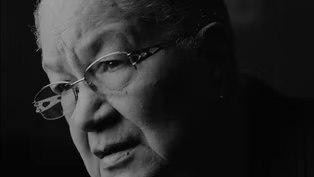
True North: Canadian Myths and Black Power | Trailer
Video has Closed Captions
Preview: S27 Ep14 | 30s | Global Black liberation movements converge in 1960s Montreal. (30s)
Providing Support for PBS.org
Learn Moreabout PBS online sponsorship










Support for PBS provided by: