
Gisèle Pelicot chronicles resilience after abuse in new book
Clip: 4/1/2026 | 14m 23sVideo has Closed Captions
Rape survivor Gisèle Pelicot’s 'A Hymn to Life' chronicles resilience after abuse
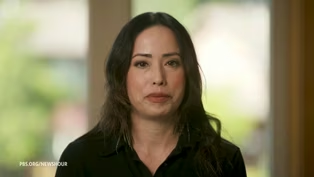
In 2020, Gisèle Pelicot was called to a police station and life as she knew it ended. She learned that her husband had been drugging and raping her and inviting strangers to abuse her for nearly a decade. The case led to a reckoning about sexual abuse and revealed the power of one woman’s voice. Amna Nawaz sat down with Pelicot to discuss her book, "A Hymn to Life: Shame Has to Change Sides."
Problems playing video? | Closed Captioning Feedback
Problems playing video? | Closed Captioning Feedback
Major corporate funding for the PBS News Hour is provided by BDO, BNSF, Consumer Cellular, American Cruise Lines, and Raymond James. Funding for the PBS NewsHour Weekend is provided by...
Support provided by:

Gisèle Pelicot chronicles resilience after abuse in new book
Clip: 4/1/2026 | 14m 23sVideo has Closed Captions
In 2020, Gisèle Pelicot was called to a police station and life as she knew it ended. She learned that her husband had been drugging and raping her and inviting strangers to abuse her for nearly a decade. The case led to a reckoning about sexual abuse and revealed the power of one woman’s voice. Amna Nawaz sat down with Pelicot to discuss her book, "A Hymn to Life: Shame Has to Change Sides."
Problems playing video? | Closed Captioning Feedback
How to Watch PBS News Hour
PBS News Hour is available to stream on pbs.org and the free PBS App, available on iPhone, Apple TV, Android TV, Android smartphones, Amazon Fire TV, Amazon Fire Tablet, Roku, Samsung Smart TV, and Vizio.
Providing Support for PBS.org
Learn Moreabout PBS online sponsorshipAMNA NAWAZ: One November day in 2020, Gisele Pelicot was called to a local French police station, and life as she knew it ended.
Evidence mounted that her husband of 50 years had been secretly drugging and raping her and inviting dozens of strangers into their home to abuse her for nearly a decade.
Her resilience and resolve in a trial of over 50 men later led to a reckoning about sexual abuse and revealed the power of one woman's voice.
I met with Pelicot this week for a rare interview to discuss the publication of her memoir, "A Hymn to Life," with the subtitle "Shame Has to Change Sides."
And I began by asking her what it's like for her to now have her story out in the world.
GISELE PELICOT, Author (through translator): I thought that my book could be useful, and to tell my story could tell the others who are victims of sexual violence that we have the resources within us to get back up and, through my story, where I write about a family saga of three generations of women that gave me the strength and this happiness in life, because they also lived through disease and grief.
But I always saw them as strong.
It is really this happiness that did not leave me throughout my childhood, and this resilience that is something within me.
AMNA NAWAZ: The more you speak about it, does it get easier at all to talk about all of this?
GISELE PELICOT (through translator): Easier, I don't think so, because I lived 50 years with Mr.
Pelicot, and it was my choice to live with him.
And I had three children.
And I always thought that these 50 years were not all a lie.
To be able to continue living, I have to rebuild a new perspective and almost invent it and also understand who I am.
AMNA NAWAZ: Before we go into more detail about your case, tell us about the man that you thought you were marrying, because, as you note in the book, you were very young when you both met.
You were escaping your own traumas.
He was escaping a very abusive household as well.
Who did you believe you were marrying 50 years ago?
GISELE PELICOT (through translator): So, when we met, we were two 19-year-old kids.
He had very difficult moments, a tyrannical and authoritarian father.
And I had a stepmother who was not loving, not loving at all.
It was another way to convince ourselves that we could save each other and that we could help each other.
And that's what I believed for many years.
We had to learn together, but we had always gotten over the obstacles, disease, financial challenges, and problems at work.
AMNA NAWAZ: You were living this very idyllic life, retired in the South of France.
You have a pool in the house.
The grandkids come to visit.
And everything changes in a moment when your husband reveals to you he's been arrested.
He was caught filming up women's skirts in a local store.
The police will want to talk to you.
In that moment, to be confronted with this with a man you have spent most of your life with, what is that like?
GISELE PELICOT (through translator): It was a moment where it was hard for me to understand what happened, because we have chosen this place to have a peaceful retirement, to be able to receive our children and our grandchildren.
It was a magical place to make others happy.
And when Mr.
Pelicot told me that he was caught filming under women's skirts, I was destabilized, because he had never done anything to me.
I have never seen him do anything out of place, like, suspicious or violent towards women.
I had to confront the reality, but I told myself that maybe he had these urges, and maybe I could help him, get him a psychological evaluation, and ask for forgiveness from these women.
AMNA NAWAZ: In that moment, Mr.
Pelicot knew that the police knew more about his crimes.
They have his computers.
They will have found the videos at that point, a file, a folder on his computer labeled abuse, videos of you being raped repeatedly by him, by dozens of other men while you were drugged into unconsciousness.
He doesn't tell you any of that, though.
The police have to tell you that.
When you're presented with this evidence and told what has been happening for the last decade, what goes through your mind?
GISELE PELICOT (through translator): It was very hard for me to imagine that it was true, and I thought it was Photoshopped videos.
I even thought that maybe somebody had something against Mr.
Pelicot.
Maybe it was a form of denial, but I think my brain really dissociated.
I could not realize the evil things that he had done.
Because the images were very violent, for me it was intolerable, so my brain dissociated.
And it's when I got home that, after five or six hours, I pronounced for the first time the word rape to a friend that came to see me so I could go sleep at her house that night.
That day, it's true that my life stopped.
It was very difficult and very painful.
We cannot imagine something so vile, so inadmissible, so unthinkable.
Everything was falling apart in my life at that moment.
AMNA NAWAZ: There are almost incomprehensible numbers.
You lay out in the book and we have seen in reports over 70 men in those videos, over 200 rapes.
For the man that you loved and shared your life with, to even do this once would be an extraordinary betrayal, but how do you begin to reconcile the scale of the deception and the abuse?
GISELE PELICOT (through translator): It was for like 10 years I had these memory lapses.
I consulted with neurologists, with gynecologists.
Nobody understood what was happening to me, also because we could not imagine that a woman who was accompanied by her husband, nobody could imagine that she was being drugged within her own home.
I am lucky that my body held up.
AMNA NAWAZ: You also write in the book that it's left to you to have to tell your children, your adult children.
And that, on top of your own trauma, your own shock, you, as a mother, you have to try to carry their trauma and their shock and their pain.
What is that like in that moment?
GISELE PELICOT (through translator): That was the hardest moment of my life, to call my children, because I did not know how to explain all of this.
This feeling of betrayal, everyone felt it.
It was complicated for them because they did not choose their father.
I chose him, and they did not.
So, for my children, they wanted to erase everything.
They wanted to destroy everything, because it was unbearable.
How could he have betrayed us like this, lie to us like this and hurt us this way?
The children still suffer.
AMNA NAWAZ: Your sons, your two sons deal with this in their own way, but your daughter Caroline, she struggles immensely, as you document.
And it's especially after photos of her are found on your husband's laptop, photos of her while she's sleeping she didn't know about, photos you describe as having what you call an unbearable incestuous gaze.
And so she naturally questions whether she herself could have been abused by her father.
Madame Pelicot, do you believe that Monsieur Pelicot could have abused your daughter, Caroline?
GISELE PELICOT (through translator): There are two photos that make us question what happened where she is in a hoodie and underwear.
She looks like she's sleeping on her side.
But there's no answer, because we don't see anything.
We don't see Mr.
Pelicot raping her or other people.
Of course, this incestuous gaze upon his daughter is intolerable, and I understand that Caroline is suffering.
And, for her, this doubt condemns her to a continuous hell.
And she filed a complaint against her father, and I hope that she will have answers.
Me today, I don't have an answer, but I try to be with her as she looks for the truth.
Now we're back to this mother-daughter relationship like we had before.
But this story has destroyed our lives, and we're trying to heal altogether.
AMNA NAWAZ: I'd like to ask you about the trial, because you write in the book that, for years, you resisted, you refused watching those videos, I assume as a form of self-protection.
But before the trial, your lawyers tell you that you should to be ready.
So, you watch these videos of your own assaults, one after the other.
And I'm curious, when you have so deliberately held this boundary for so long, and suddenly that boundary is gone, what changes for you, if anything?
GISELE PELICOT (through translator): These images are etched in my memory forever.
When we see the body of this abused woman who is given to these men who have no pity, we cannot describe videos of such horror.
So it helped me to think that this woman was not me, because she was just like a rag doll who had no more soul, no more life, who was being abused.
I told myself that I had to take the punches like a boxer, and I watched the videos one after another.
But, after a time, once I had finished screening the videos, I needed to walk for hours to tell myself that I have to do something.
I have to expose all these individuals so that they will pay dearly for what they did.
It was for them to bear the burden of shame, not the victims.
AMNA NAWAZ: There are over 50 men in that room, the largest mass rape trial in French history.
It is you against 50 men.
And you make what many consider to be an astonishing decision, that you don't want this to be a closed trial, to make sure the public knows what's happening inside that room.
Why?
GISELE PELICOT (through translator): I felt invested and felt like I had a responsibility.
And I had thousands of letters who came from all over the world that were just addressed to Gisele Pelicot France or Avignon.
I never thought that my voice could echo throughout the world beyond our borders.
And a lot of women identified with me, because it was an echo to their own suffering.
AMNA NAWAZ: For the first time, in that room, you are confronted with the faces and the voices of these men who committed unspeakable acts of brutality against you.
What's it like to see them there in that room?
GISELE PELICOT (through translator): What is shocking is that, when we see them, they are ordinary men.
Some are very young, from 22 to 70 years old.
I am not sure they even realize why they were there, because their behavior looked rather detached, without any empathy towards the victim.
They were even in denial and acted with cowardice.
That's what I lived through in these 3.5 months of trial.
I had to confront their lies, their denial, their sarcasm, their inappropriate looks.
The women who were outside made everything inside the trial more peaceful, there with the applause when I got out and when I came in, in the morning.
I believe that, without that support, it would have been even harder for me.
AMNA NAWAZ: So, Monsieur Pelicot is found guilty, sentenced to 20 years in prison.
And every other single man in that room is also found guilty.
Is it a moment of relief or justice?
GISELE PELICOT (through translator): Not relief, no.
I believe justice played its role and was able to name the crimes, recognize the suffering of the victim, and recognize that the crime should not go unpunished.
So that was a victory for me.
AMNA NAWAZ: Meanwhile, there are men who were not identified from the videos, who could not be caught, who are still out there.
What is that like for you to know that?
GISELE PELICOT (through translator): They must not have peace of mind, because they know that they must be watched from somewhere.
There are nine that we were unable to identify because their faces were blurred.
But maybe one day, we will be able to identify them.
AMNA NAWAZ: As you well know, your case, this trial, your story have now been splashed across global headlines, women showing up and chanting your name, Gisele, over and over again, becoming a global icon, someone that so many women look up to and find as a source of strength and resilience.
What's that like for you right now?
GISELE PELICOT (through translator): I am just a regular woman who was opposed to a closed trial.
I really like the word whistle-blower.
The historian Michel Perreault (ph) named me whistle-blower.
That is a word that describes me better, because I actually awakened people's collective conscience.
This is a name I like, and I believe that the next generation will continue the fight.
AMNA NAWAZ: You have also said that you would like to visit Monsieur Pelicot in prison.
Have you had a chance to do that yet?
GISELE PELICOT (through translator): No.
No.
First, I would not use the word chance, but I will go see him when I have a moment.
I have a very busy schedule.
No, I was not able to speak with Mr.
Pelicot since the 5.5 years of this trial, because every time I spoke to the president of the court when I had to speak to Mr.
Pelicot, yes, I have the intention of doing it, but that stays in my personal sphere.
AMNA NAWAZ: Why do you want to speak with him?
What do you hope you would get from that meeting?
GISELE PELICOT (through translator): I have the need to ask questions.
Why did he make us suffer this much?
Why did he not stop before?
Of course, these are questions that are still with me.
I don't know if I will be able to get answers, but I hope.
AMNA NAWAZ: I'm so happy to ask you about this as well, because, despite it all, you have found love.
You have found partnership and intimacy and trust, a man named Jean-Loup, who's here with you today.
And a lot of people will wonder how you do that.
How do you trust someone else after everything you have been through?
GISELE PELICOT (through translator): I believe that trust is part of the way I live.
It is true that I met this man.
I did not think that I would fall in love or even have wanted to, but life has changed trajectory.
And I met this young man of 73 years old, and he's also had some complicated times in his life.
Also, we met through friends, so I did not meet him randomly.
And I believe that changed our lives.
We hope to really enjoy our life together.
And he's with me and supports me while I do this book tour.
And I completely trust him, because we have the same values, and it's something very important.
AMNA NAWAZ: The book is "A Hymn to Life: Shame Has to Change Sides."
And the author is the extraordinary Gisele Pelicot.
Madam Pelicot (SPEAKING IN FOREIGN LANGUAGE).
Thank you so much.
GISELE PELICOT: (SPEAKING IN FOREIGN LANGUAGE)
 New
NewArtemis II launch sends 4 astronauts on mission around moon
Video has Closed Captions
Artemis II launch sends 4 astronauts on mission around the moon (5m 33s)
 New
NewA Brief But Spectacular take on identity and art
Video has Closed Captions
A Brief But Spectacular take on channeling identity through art (2m 29s)
 New
NewNews Wrap: Johnson, Thune agree on path to fund DHS
Video has Closed Captions
News Wrap: Johnson, Thune agree on path to fund DHS through September (6m 11s)
 New
NewSupreme Court hears birthright citizenship case
Video has Closed Captions
Analyzing the arguments as Supreme Court hears birthright citizenship case (10m 2s)
 New
NewSupreme Court visit highlights Trump's focus on immigration
Video has Closed Captions
Trump’s Supreme Court attendance highlights his focus on immigration (5m 31s)
 New
NewTrump signals war could end soon, gives mixed signals on how
Video has Closed Captions
Trump signals Iran war could end soon but gives mixed signals on how (8m 18s)
Providing Support for PBS.org
Learn Moreabout PBS online sponsorship
- News and Public Affairs

FRONTLINE is investigative journalism that questions, explains and changes our world.

- News and Public Affairs

Amanpour and Company features conversations with leaders and decision makers.












Support for PBS provided by:
Major corporate funding for the PBS News Hour is provided by BDO, BNSF, Consumer Cellular, American Cruise Lines, and Raymond James. Funding for the PBS NewsHour Weekend is provided by...