
Stone Age Temple Mystery
Season 53 Episode 6 | 53m 25sVideo has Audio Description
Surprising evidence at the world’s oldest temple overturns our understanding of human history.
Surprising evidence at the world’s oldest temple overturns our understanding of human history. The latest excavations at the 12,000 year-old Göbekli Tepe in Turkey are making archaeologists rethink the roots of civilization.
See all videos with Audio DescriptionADProblems playing video? | Closed Captioning Feedback
Problems playing video? | Closed Captioning Feedback
National Corporate funding for NOVA is provided by Carlisle Companies and Viking Cruises. Major funding for NOVA is provided by the NOVA Science Trust and PBS viewers.
Support provided by:


Stone Age Temple Mystery
Season 53 Episode 6 | 53m 25sVideo has Audio Description
Surprising evidence at the world’s oldest temple overturns our understanding of human history. The latest excavations at the 12,000 year-old Göbekli Tepe in Turkey are making archaeologists rethink the roots of civilization.
See all videos with Audio DescriptionADProblems playing video? | Closed Captioning Feedback
How to Watch NOVA
NOVA is available to stream on pbs.org and the free PBS App, available on iPhone, Apple TV, Android TV, Android smartphones, Amazon Fire TV, Amazon Fire Tablet, Roku, Samsung Smart TV, and Vizio.
Buy Now
Keep Exploring
NOVA Labs
NOVA Labs is a free digital platform that engages teens and lifelong learners in games and interactives that foster authentic scientific exploration. Participants take part in real-world investigations by visualizing, analyzing, and playing with the same data that scientists use.Providing Support for PBS.org
Learn Moreabout PBS online sponsorship♪ ♪ NARRATOR: High on a hill in Turkey... one of the most important archaeological discoveries of our time.
MICHAEL MORSCH: We thought these are the ruins of a lost civilization.
NARRATOR: An ancient wonder, 12,000 years old; over 6,000 years older than Stonehenge.
FATMA SAHIN: Oh, my God!
NARRATOR: A mysterious collection of circular structures lined with massive stone pillars, adorned with carved creatures.
What were these monuments for?
MORSCH: We never expected monumental architecture.
This was totally new.
NARRATOR: Who were the people who gathered here?
LEE CLARE: Human remains are special.
These are the people that built the site.
These are the people who lived here.
NARRATOR: Now, new discoveries are leading some archaeologists... Wow.
NARRATOR: ...to rethink their most basic ideas about the origins of civilization.
FERRAN ANTOLIN: It's a very strong indicator that the settlement was permanent.
NARRATOR: "Stone Age Temple Mystery."
Right now, on "NOVA."
♪ ♪ ♪ ♪ NARRATOR: In Southern Turkey, hidden beneath a modern protective canopy... ...a mysterious collection of stone structures.
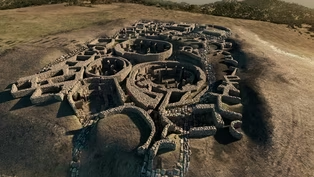
This is Göbekli Tepe.
Named for the hill it stands upon.
Here, towering stone pillars, some 18 feet tall, stand guard in nine circular enclosures up to 65 feet across.
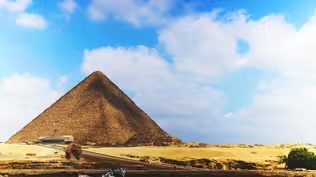
Older than the Great Pyramid of Giza.
Older, even, than Stonehenge.
For over 30 years, archaeologists have been trying to solve the riddle of this enigmatic site.
(drone whirring) But now, with new technology... ...unearthing new discoveries... Fantastic.
NARRATOR: ...we may finally have answers to the questions scientists have been asking for years.
Who built this place?
For what purpose?
And why was it abandoned, with all traces of human settlement ending thousands of years ago?
♪ ♪ In 1994, archaeologist Michael Morsch was part of a small group who set out across the landscape... in search of a rumored hilltop site.
Talked of since the 1960s, but never explored.
MORSCH: This is the road we took when we first discovered Göbekli Tepe.
NARRATOR: It was the first team to investigate the site, led by German archaeologist Klaus Schmidt.
We saw all these masses of flints on the ground and we saw these T-shaped pillars.
NARRATOR: Knowing they'd come across something special, they returned the following year to begin the excavation.
Over the next 14 years, one of the most remarkable sites ever discovered slowly emerged from the earth.
Sweeping, curved stone walls lined with monolithic pillars.
Some covered in reliefs of animals, and some depicting human figures.
MORSCH: We had the feeling this is the neolithic gold mine.
We thought these are the ruins of a lost civilization.
NARRATOR: Using digital technology to remove modern structures, it's possible to see the hillside as those first archaeologists encountered it.
They uncovered four great circular buildings.
Archaeologists labeled them A, B, C and D. Archaeologist and architect Moritz Kinzel has studied the site for almost ten years.
He's trying to piece together a chronology of the structures.
Inside Building B, he has identified layers of walls.
KINZEL: What we have here is the outer wall, with this niche feature and then we have the second wall in front of it, with what looks like a bench but it's actually a wall and where we are now actually standing on is the third wall and on the other side we have the fourth wall.
NARRATOR: Radiocarbon dating of the mud mortar from the remaining walls has revealed that they were constantly being altered and renovated.
The architecture at Göbekli Tepe was not built at once, it was growing over time, but inwards.
So what we see here in the background is also the oldest wall of Building B and then building phases are built inside the structures and making the buildings over time smaller.
♪ ♪ NARRATOR: The four circular buildings were reshaped over time.
The team has dated the oldest outer walls to around 9,600 BCE... ...with three inner walls, each constructed 300 to 500 years apart.
Until building appears to have stopped.
KINZEL: We know that the buildings at Göbekli Tepe had a lifetime over 1,500 years.
NARRATOR: The dating places Göbekli Tepe right at the start of a period during the Stone Age known as the Neolithic.
♪ ♪ A time of radical change for our ancestors that saw them adapt from living in small nomadic groups and eating wild plants and animals... ...to settling in larger communities and experimenting with rearing livestock and cultivating crops.
♪ ♪ The question is, how does Göbekli Tepe fit into this story?
Archaeologist Lee Clare is field director of the excavations.
He believes there are clues in the design of these circular structures... ...and T-pillars.
CLARE: The T-pillars are depictions of the human form, albeit very stylized.
We have the shaft here which is the body, and the top of the T of course, is the head of the individual without any facial features.
We have on this broad side the arm coming down the forearm and of course the hands at the bottom resting on the stomach.
This stripe here is actually the belt of the individual, and hanging down from the belt buckle, we have the loin cloth made from a fox fur, so that's seen as a good indication of the clothing that was being worn at the time.
NARRATOR: Lee believes the design of this space echoes how it was used 12,000 years ago.
CLARE: We certainly have two very important individuals standing here in the center of the building, depicted at great height, five-and-a-half meters tall, centrally facing towards the south.
But in the surrounding walls around us there are a dozen more pillars incorporated into that wall and each of these was representing an individual.
What we have here is actually a community sitting down, discussing.
NARRATOR: Huge numbers of animal bones found here hinted at feasting.
CLARE: It's like a piece of animal horn core.
Probably a gazelle or something like that.
NARRATOR: Leading to the conclusion that these structures were communal ritual spaces.
That led archaeologists to name them "Special Buildings."
♪ ♪ But with few obvious signs of living spaces... ...and no apparent water supply... ...researchers believed that this was a site built by nomadic hunter-gatherers who came together here for seasonal feasts.
♪ ♪ It was dubbed, "The Cathedral on the Hill."
But the radiocarbon dates mean that prehistoric peoples must have constructed this vast ritual site at Göbekli Tepe, before pottery... metalworking... ...or even the wheel.
Forcing researchers to rethink what they understood about early Neolithic people.
CLARE: The assumption was that hunter-gatherer communities were not capable of constructing a site like Göbekli Tepe.
It was thought that first you needed agriculture and organized society to have this sort of a building.
MORSCH: The received wisdom about hunters and gatherers was mobile groups.
We expected shamanistic rituals, dances in small groups.
But we never expected rituals in sites with monumental architecture.
This was totally new.
♪ ♪ NARRATOR: Who were the people that built Göbekli Tepe?
The age of the site points to hunter-gatherers.
Yet monumental ritual spaces were thought to be tied to the development of agriculture.
So were these people hunter-gatherers or farmers?
And what did they do here?
(translated): What was their purpose?
Were they nomadic?
What kind of lifestyle did they have?
These are the things we are curious about.
♪ ♪ NARRATOR: In 2012, ground-penetrating radar revealed the Göbekli Tepe site extended beyond these first four special buildings.
Showing more solid structures underground to the north and west.
(Lee speaking Turkish) Lee and his team are exploring this larger plot, slowly exposing more stone walls.
♪ ♪ Over the past ten years, dozens of smaller stone structures have been uncovered.
CLARE: We have a very dense agglomeration of buildings around the slope.
These aren't monumental buildings.
They're much smaller, four or five meters in diameter, sometimes even smaller than that.
NARRATOR: Dating these buildings places their construction more than 500 years later than the earliest walls of the special buildings.
Were they simply spaces for preparation for the feasting and rituals that took place in the special buildings?
♪ ♪ Or did they have some other purpose?
Have a look.
Oop!
It's like a shallow bowl on the floor, doesn't it?
Yeah.
That's really fantastic.
NARRATOR: In a world before pottery, any kind of containers for storage, cups or bowls, would have been made from wood, bone, or carved from solid stone.
CLARE: Now this space is very small, too small to actually be used for habitation, but what we could be looking at here is obviously a storage area.
NARRATOR: Even after being buried for more than 10,000 years, the stone vessel could still contain clues as to what these small walled areas were for.
CLARE: Inside the bowl, of course, the contents seems to be preserved.
I mean, of course, we'll take the contents here and send it off for analysis, for floatation, for various things, and look if we can perhaps see what was inside it.
NARRATOR: Earth from the bowl and from the surrounding space, is sent off for analysis.
Anything of archaeological interest can be isolated... ...using a specially designed floatation tank.
Archaeo-botanist Ferran Antolín and PhD student Núria Morera Noguer sift through bones, flints and plant remains.
Lots of flints, splinters.
Yeah.
NARRATOR: The process will split the sample, washing away sediment and separating what's left by what floats and what sinks.
NOGUER: The light fractions float into the water tank.
The heavy fraction stays here with this huge mesh, and all the other sediment goes down to the bottom of the tank.
There's quite a lot of charred material in the light fraction.
NARRATOR: The floating light fraction will contain prehistoric plant remains.
Flints and bones will sink.
Oh, look, (laughs) The finger bone.
Finger bone.
So here is the heavy fraction.
We have this finger bone, here, from an animal, possibly a gazelle-- we also find this tarsus, so it's part of the paw of the animal.
NARRATOR: It was the discovery of large numbers of animal bones in the special buildings that led to the ritual feasting theory.
For the team's zoo-archaeologist Stephanie Emra, deeper analysis of bones found across the site can reveal more about what animals were being eaten.
EMRA: So, in terms of the number of bones on the site we've probably looked at... over 100,000.
NARRATOR: Many of the fragments are poorly preserved.
And the first challenge is identifying which bones came from which species.
I've seen a lot of gazelle, so, these little vertebra, gazelle ribs-- some of the larger stuff are from cattle, so the aurochs.
We found boar, sheep.
NARRATOR: While gazelle make up more than half of the identified bones, the presence of what seem like familiar farm animals, such as cattle and sheep, raises the possibility that the people of Göbekli Tepe were farming their food.
Stephanie's research is trying to distinguish whether these bones are from domesticated herds or their still-wild ancestors.
EMRA: In a controlled herding environment, you would have more adult females and young males being killed off and this is not something that we see.
We would also see a shift in the size of the animals, so domestic animals tend to be a bit smaller than their wild counterparts.
NARRATOR: Early farm animals were mostly smaller than their wild relatives, due to poorer nutrition and being penned into enclosures rather than running free.
I have these examples.
This one is from Göbekli.
And this one is from a medieval site in Germany.
And you can see the massive size difference.
You can never really say from just one bone, whether it's going to be a wild population or domestic population, but having thousands of bone fragments, you can then get an idea of the, sort of, size of the animals.
NARRATOR: The animal bones found at Göbekli Tepe suggest the animals eaten here were wild.
(fire crackling) The people here didn't keep livestock... ...but slaughtered wild animals.
In addition to the heavier bone evidence, the lighter material from the floatation tank is also filled with clues.
ANTOLÍN: The floatation process is essential.
It's the only way we can recover a representative amount of the plant remains that accumulated in the site.
NARRATOR: Ferran Antolín is an expert in ancient plants.
ANTOLÍN: Most of them are beyond one millimeter of size.
Very small seeds, charcoal fragments, allow us to reconstruct both the diet and the landscape around the settlement.
NARRATOR: The smallest fragments, charred by ancient fires, hold clues to what the people who came here ate.
ANTOLÍN: We are looking for charred seeds and charred pieces of wood, because these are the only organic plant material that preserves in dry sites.
NARRATOR: Among the microscopic, blackened plant remains, Ferran finds more fragments of one plant than any other.
♪ ♪ A kind of wheat, called einkorn.
ANTOLÍN: It grew around Göbekli Tepe, it was probably intensively harvested by people living at the site.
Since we started the new analysis in 2023, we've been able to see that einkorn is the most frequent plant that we are identifying.
NARRATOR: Einkorn was one of the world's first domesticated grains.
But Ferran's research is revealing something surprising about the einkorn eaten at Göbekli Tepe.
ANTOLÍN: Wild plants disperse their seeds on their own.
That's the goal; that their seeds just produce new plants.
In wild einkorn, those seeds just fall off the ear themselves.
It's called shattering ear.
NARRATOR: This shattering ear allows seeds to spread naturally.
But domesticated, farmed einkorn is different.
ANTOLÍN: This is the ear of domesticated einkorn.
And all of the spikelets are still attached to the central axis, what we call the rachis.
And it means it's a non-shattering rachis.
NARRATOR: Domesticated einkorn rachis are more robust, allowing for the ears to be harvested intact.
The einkorn seeds Ferran is finding at Göbekli Tepe are all from ears with shattering rachis.
This is wild einkorn.
ANTOLÍN: The fact that we have wild einkorn at Göbekli Tepe is indicating that people were not yet cultivating the plant, but they were harvesting intensively.
NARRATOR: Until archaeologists find clear markers of early crop cultivation, like the presence of certain weeds that thrive in tilled soil, the evidence suggests the einkorn was gathered from the wild, not planted fields.
When coupled with the wild animal bone evidence, it points to the people at Göbekli Tepe being hunter-gatherers, not farmers.
And looking at the plant remains beyond einkorn reveals something else about the people who came here.
ANTOLÍN: We've been able to find different types of plant resources, such as wild cereals and legumes, which were harvested mostly in spring and early summer period, loads of fruits and nuts that would be most typically harvested by the end of summer and autumn.
♪ ♪ NARRATOR: The discovery is forcing researchers to rethink the traditional view of the people who visited Göbekli Tepe.
That they were nomadic hunter-gatherers who camped across the surrounding plains throughout the year... ...congregating here for occasional celebrations.
ANTOLÍN: We observe a diversification of gathered resources that would be available in different months of the year.
So instead of having a mobile camp that would allow a population to follow a resource in the landscape, this population at Göbekli Tepe, benefits from a number of resources that are available in different times of the year, and that can be stored.
This allows them to actually become sedentary.
NARRATOR: For decades, scientists thought hunter-gatherer societies always moved with the seasons, following herds of animals.
But now, the finds at Göbekli Tepe are telling a story of a settled community exploiting the abundant wild plant and animal life that surrounded them.
This was a place to live.
But if hunter-gatherers settled at Göbekli Tepe, where are their houses?
In one of the structures clustered around the Special Buildings, Lee is finding evidence of daily life.
This rectangular structure features numerous elements which are clearly domestic.
This reminds us a bit of a modern home in a way, We have a bench here to my right, and in that bench we have actually a grinding stone.
Whether this was used for actually grinding, whether it contained liquid, perhaps water, but it's very much like a worktop with a sink, if you like.
NARRATOR: And there's another discovery on the opposite side of the room.
CLARE: We've got this Stone Age cupboard ideal for storage with this wonderful limestone vessel, so we've got this Stone Age furniture as it were, and very reminiscent of "The Flintstones" in fact.
So this would have been a household kitchen situation, perhaps a family unit, using this space to prepare meals.
All this is pointing to domestic life.
NARRATOR: Lee believes many of the structures packed on the slopes were homes, covered spaces for permanent residence, huddled around the Special Buildings at the heart of Göbekli Tepe.
When combined with the bone and seed discoveries, the infrastructure here, with grand ceremonial buildings, and dedicated living spaces, hints at a society in transition.
Still foraging, but now more permanent.
CLARE: We're dealing with a very complex settlement structure very much contrary to what people generally think when we say Neolithic or Stone Age.
At its peak, if the entire area were to have been occupied, I wouldn't be surprised if we're looking at anything from 500 to over 1,000 people living at Göbekli Tepe.
NARRATOR: The scale is surprising.
Stretching over 22 acres, 20 monumental buildings and perhaps more yet to be uncovered.
A settlement that could have supported more than 1,000 people.
It's just one of a handful of early neolithic settlements so far discovered in the region.
Jericho was big enough for over 2,000 people.
Tell Abu Hureyra was home to a few hundred.
But if Göbekli Tepe was a settlement where people lived across 1,500 years... ...where are their remains?
During over 30 years of excavation, only fragments of human bones had been discovered.
But more recently, that has changed.
Now, in one of the walled structures beyond the special buildings... KINZEL: Yeah, this is quite exciting to see.
NARRATOR: ...the researchers have found a burial site with human remains.
Yeah, wow.
CLARE: So what we've got here, obviously, is a skull, and a few long bones here.
So, it's a burial.
Really, really exciting to have.
CLARE: So another individual from Göbekli Tepe.
It can tell a story.
Yeah.
NARRATOR: It's only the third burial to be discovered at the site.
Human remains are special.
I mean, these are the people that built the site.
These are the people that lived here.
NARRATOR: And Lee sees something right away that could make these remains even more special.
CLARE: The bones-- they're not fused.
The skull is quite small.
At the moment, we were thinking that it's probably the remains of a child.
NARRATOR: For Lee and Moritz, the placement of the body within a decorated niche inside a domestic space gives clues about the belief systems of the people that lived here.
KINZEL: By bringing somebody's bones back into the house, it's somehow claiming ownership, so the dead and the living are living together, say, they are part of the same cosmos.
NARRATOR: This new discovery adds to previous analysis of skull fragments found across the site.
JULIA GRESKY: These pictures are from the first skull I found in Göbekli Tepe.
NARRATOR: 1,600 miles from the dig, in her lab in Berlin, paleopathologist Julia Gresky has been examining the skull fragments.
Here, we have a lot of wild cut marks.
NARRATOR: At high magnification, she has identified unnatural markings on the bone fragments.
This is something that you would expect when de-fleshing a skull.
If you want to cut away the soft tissue, then you would just scrape on the surface.
These incisions were done while the bone was still fresh, but you can't say that they were done during life, because there are no signs of healing on this incision.
NARRATOR: The evidence suggests these skulls were stripped of flesh after death.
And there are more markings.
GRESKY: This skull has three main carvings on the frontal part.
It is several repeated scratches in this big line.
NARRATOR: Julia believes these and other marks found on the skull were made intentionally.
The reason is a mystery.
But another clue has led her to a theory of how the skulls may have been used.
GRESKY: We found that one of these skulls had a drilling hole.
NARRATOR: The hole was bored through the cranium, right at the top of the skull.
GRESKY: Maybe they were trying to fix things on the skulls or they wanted to hang them with a cord.
NARRATOR: Red marks found on some bone fragments suggest the skulls could have been decorated and put on display.
GRESKY: The markings on these skulls, they point to some ritual tradition, so a special focus on the skull of these people.
(flames crackling) NARRATOR: It's possible a so-called "skull cult" was practiced by the people of Göbekli Tepe.
GRESKY: A skull cult is a practice of venerating dead people or memorizing important people of their own family, of the community in general.
NARRATOR: The skull from the burial shows no signs of decoration.
But the practice of burying bones within living spaces here and at later neolithic sites is a telling clue about how human societies were changing.
Perhaps the tradition began at Göbekli Tepe.
GRESKY: When people build communities, it's very important to have this, this group feeling, and to belong to somebody.
Ancestors played a big role in that.
CLARE: This really means that the, the dead were kept close to the living, and this emphasizes the importance of the dead, the ancestors in this community.
NARRATOR: The settlement structures, the sheer volume of finds, and the burials and skull remains lead many archaeologists to conclude this was a place inhabited year-round.
♪ ♪ (flames crackling) Yet these people were hunter-gatherers who were not relying on farmed plants or animals.
How were they able to survive year-round in this landscape, which is so dry and challenging today?
♪ ♪ The diversity of ancient animal and plant remains discovered here suggests a different kind of environment 12,000 years ago.
ANTOLÍN: The biodiversity of the landscape around Göbekli Tepe was certainly higher than what it is today.
It was wetter, and it would even allow slightly denser forests nearby the settlement, so there would be parts of the landscape that would be seasonally greener.
CLARE: At the time of Göbekli Tepe, the climate was slightly different.
It was a lot wetter, more rainfall.
♪ ♪ NARRATOR: On the hillside, just yards from the Göbekli Tepe site, Lee has found evidence that suggests the people that lived here... ...may have shaped the hillside to take advantage of that rainfall.
So, this is not natural, it's artificial.
It's carved into a natural plateau.
It's a channel, as you can see, and it's, it's directing the runoff rainwater from upslope down this cliff face.
♪ ♪ NARRATOR: As Lee's team looked further, they found large human-made holes.
CLARE: So, as you can see here, we have a shallow pool here, and a channel actually leading down.
NARRATOR: A rainwater harvesting system.
CLARE: We have a row of water channels which were carved into the bedrock, which are actually directing the rain water down from the site, down slope, into cisterns like this.
(raindrops pattering) NARRATOR: If people did settle permanently at Göbekli Tepe, a secure water supply was vital.
This system may have helped provide that.
CLARE: These cisterns are really quite remarkable, I mean, it's ingenious, in fact.
People were harvesting the rainwater here at Göbekli Tepe.
This is something which would have been essential for the people at the time to live at this site.
♪ ♪ NARRATOR: And there are more traces of human activity that shaped the environment for survival.
(speaking Turkish) (translated): All this landscape you see around us really holds the clues to how hunter-gatherer people lived at Göbekli Tepe.
(speaking Turkish) NARRATOR: Using satellite images, archaeologist Fatma Sahin and her team have identified something she believes could explain how such a large population fed itself.
(translated): Now we're going to a place we define as an animal trap.
♪ ♪ NARRATOR: On the ground, the structures appear as long, low stone walls.
But their true scale and design becomes clearer... SAHIN (speaking Turkish): NARRATOR: ...when seen from the air.
SAHIN: Oh, my god!
(speaking Turkish): (translated): We weren't actually sure whether there was a trap area here.
We came to investigate it, but now, when we flew the drone, we can see there really is a trap site there.
We can see it very well-preserved.
♪ ♪ NARRATOR: Sometimes extending more than three miles, these structures are called desert kites-- named for their angular shapes when viewed from above.
This one is some 24 miles from Göbekli Tepe, but structures like this are spread across the landscape.
The nearest so far discovered is just a couple miles from the site.
Archaeologists have determined that they were most likely made to herd, corral, and ultimately trap migrating animals.
SAHIN (translated): They were built along animal migration routes, by watering spots, stream banks, and on slopes.
They collected stones from the slopes and from the land all around them using a technique called dry-stone walling, they created giant mega structures.
♪ ♪ NARRATOR: This kite is a new discovery for Fatma, and so needs deeper research.
But from first impressions, examining the flint blades scattered along the walls... and the structure's similarity to other early Neolithic kites, Fatma believes this could have been constructed during the 9th millennium BCE, perhaps when Göbekli Tepe was at its height.
The scale is staggering.
(translated): The traps can cover an area of 40, 50, even 100 hectares.
By driving animals down the slopes, hunter-gatherers were able to trap them here and pen them in these structures.
(drone buzzing) NARRATOR: The kites suggest a radical idea.
(translated): Look, it's very beautiful.
NARRATOR: Hunter-gatherers here were organized on a monumental scale, coordinating over vast landscapes.
And Fatma believes these structures may have played a role in the earliest steps toward animal management.
(Sahin speaking Turkish) (translated): Most likely, animals caught here were seen to reproduce, their lives were carrying on, and in being confined here, the animals naturally began a process of domestication.
NARRATOR: The people who used these traps understood animals and their environment intimately.
No longer small bands of hunters, but a large, organized group, digging into their landscape.
♪ ♪ While the kites themselves do not prove a sedentary population, they might explain the vast numbers of bones found at Göbekli Tepe.
During hunting season, traps like these could have efficiently caught the large numbers of animals needed to feed a growing population.
(bell clanging) The wide variety of birds and small mammals found at the site and other seasonal plants show that people here were finding other sources of food when the migrating animals had left.
It's quite evident that those communities were fully sedentary and were living full-time at Göbekli Tepe.
♪ ♪ NARRATOR: Göbekli Tepe appears to have expanded from a place for special buildings to a year-round hub for sedentary hunter-gatherers, surviving on wild crops, rainwater harvesting, and desert kites for trapping animals.
The question now is, were the people at Göbekli Tepe unique for their time?
Or was this lifestyle common?
♪ ♪ 18 miles west of Göbekli Tepe is Sayburç.
For the last four years, a team of Turkish archaeologists and students has been excavating amongst the modern village, on this limestone hilltop.
They've unearthed familiar T-pillars... hidden just inches beneath the modern ground level.
EYLEM ÖZDOGAN (speaking Turkish): STUDENT (speaking Turkish): NARRATOR: Archaeologist Eylem Özdogan is the site director.
(translated): It's possible to find numerous parallels between the structures at Göbekli Tepe and Sayburç.
NARRATOR: The T-shaped pillars appear here within smaller but distinct circular spaces, with the same motifs of wild animals.
But current dating of the site places it much later than the original circular buildings and T-pillars of Göbekli Tepe.
ÖZDOGAN (translated): We're in a place that dates back to roughly the mid-ninth millennium BCE.
NARRATOR: The construction of Sayburç appears to overlap with the period when Göbekli Tepe was expanding.
But those early-established symbolic ritual elements-- the T-pillars, the carvings, and the circular structures-- seem to have been transplanted here, almost as the heart of the settlement.
ÖZDOGAN (translated): Each settlement has its own distinct character, but the cultural environment here seems to be defined by very deliberate and strict rules.
Particularly in their art, and the construction of the Special Buildings.
NARRATOR: The excavations here have so far uncovered a much larger residential neighborhood.
And, as at Göbekli Tepe, analysis of organic remains suggests only wild foods were eaten here.
So much is similar at Sayburç that archaeologists believe there must have been a sharing of ideas, of ways of life, between the two sites.
ÖZDOGAN (translated): These were complex communities consciously choosing to live in large, settled groups, creating their own complex social environment and cultural infrastructure.
NARRATOR: And Sayburç is only one of Göbekli Tepe's new-found neighbors.
More than ten T-pillar sites have been discovered in the last few years, most dating from the period of Göbekli Tepe's expansion in the mid-ninth millennium.
Each with the same animal motifs, the same monumental pillars, the same stories in stone.
♪ ♪ And this network even stretched beyond the local hillside.
♪ ♪ STEVE MITHEN: The early Neolithic throughout the region, all the way from Anatolia down to the southern Levant down to Saudi today, had many different unique sites.
But they all shared some aspects of common material culture.
So you have a sense that there's a flow of people and ideas between them, which is maintaining some degree of cultural cohesion, while each individual site is also doing its own thing.
♪ ♪ NARRATOR: Together, these sites form a web of communities stretching across the region.
And at the heart of it, in its time, the largest yet found: Göbekli Tepe.
MITHEN: Göbekli Tepe is having this huge influence throughout a whole landscape of southwest Asia.
There is a sense of cultural unity.
There was a constant flow of people and ideas, and a substantial exchange of gifts.
So, it's like a social network on a large scale.
NARRATOR: This wasn't just one site isolated in its culture and traditions.
The evidence suggests it was the beginning of something larger: a regional identity, a shared imagination.
A network of communities bound together by stone, by symbol, and by story.
♪ ♪ MITHEN: Traditionally, we've assumed that hunter-gatherers have simple lives, maybe rather simple minds.
We now know that hunter-gatherers are sophisticated and as complex as any modern humans in so many ways.
NARRATOR: Dating the buildings and the finds, archaeologists have come to the conclusion that Göbekli Tepe was at its height during the ninth millennium BCE.
New buildings were erected, old ones reworked.
Then, by around 8,000 BCE, building seems to have stopped.
Fewer archaeological finds from this period suggest much of the population left.
So, if the site was booming, why did people leave?
Moritz Kinzel thinks that the size and location of the site led to increasing problems.
When we look at the site, we have this very steep slope, heavy buildings resting on the slope.
Heavy rain and snow in winter time added a kind of trigger of instability to everything.
NARRATOR: These buildings, built on the dip of the hillside, have no real foundations... meaning collapse was always a possibility.
CLARE: The fill of the building is comprised of limestone rubble, large numbers of flint tools, animal bone, evidence that the special buildings at the lower part of the depression were actually inundated by collapsed buildings from the slopes.
KINZEL: The buildings were hit over time, again and again, by landslide events.
NARRATOR: But cracks, tilts, and fractures in the monolithic pillars are signs that the site was hit by more than just landslides.
When we excavated this pillar here, we discovered that it's leaning to the-- towards the east, and shows this severe crack, which suggests earthquake damage.
♪ ♪ NARRATOR: Modern-day Turkey is no stranger to devastating earthquakes.
The tell-tale scars on the pillars are evidence that Göbekli Tepe suffered the same forces 12,000 years ago.
We see here, a shear crack... in the T-shaped pillar shaft that is actually leaning as well to the east.
We have cracked walls, cracked pillars, leaning pillars, cracks in the floor, and what is very significant is that they're all leaning in the same direction.
And what we have seen here on this pillar, we actually also see on the other pillars in the building.
There were at least two seismic events, one in the very early phase of the site and one in the late phase of the site.
NARRATOR: For centuries, when disaster struck, the people had rebuilt-- reinforcing walls, reshaping the enclosures.
After the final earthquake, the rebuilding seems to have stopped.
KINZEL: What we see over a long time is people moving away after these destructive events.
They lack the people to reshape certain areas.
NARRATOR: The monuments fell silent.
The gatherings stopped.
After 15 centuries, a thriving hilltop community came to an end.
But the story continued.
Less than ten miles from Göbekli Tepe, on the edge of the Harran Plain, lies another ancient site: Gürcütepe.
MORSCH: Gürcütepe holds the key for what came next after Göbekli Tepe.
NARRATOR: Archaeologists digging here uncovered remains dating to the moment Göbekli Tepe was falling silent.
MORSCH: What we find here is change.
A change in architecture.
Ritual buildings disappear.
The people were more interested in functional architecture.
NARRATOR: Gone are the grand circular enclosures.
In their place: compact homes.
The T-shaped pillars and their animal carvings vanish, too.
CLARE: Monumentality had disappeared.
So, these age-old hunter-gatherer narratives were being abandoned.
MORSCH: This might mean a shift of the priorities of the society.
NARRATOR: And it's not only priorities that are changing.
Stephanie Emra has studied animal bones from the site.
EMRA: So, at Göbekli Tepe, we only find wild animals.
Whereas at Gürcütepe, we're finding much, much fewer of those wild species, and it's almost entirely sheep and goat, the domestic version.
That, alongside the age profiles of the animals and the sex ratio of the animals, that's a really clear indication that they're now herding animals.
MITHEN: A new agreed way of life, primarily would depend on domesticated crops and on herded sheep, goats, and cattle, had become accepted and universal.
NARRATOR: While earthquakes and landslides might've been the driver for people to leave Göbekli Tepe... there may also have been a draw.
CLARE: It's quite possible the population living at Göbekli Tepe moved down into the plain in order to have better conditions for farming.
MORSCH: It was flat.
They had enough water to plant, they had enough space and fertile land.
NARRATOR: This wasn't an isolated change.
Sites across these hills were abandoned as farming on the plains took root.
MITHEN: What we see is the emergence of an agricultural way of life.
♪ ♪ NARRATOR: Before the discoveries at Göbekli Tepe, many archaeologists believed that people first came together in settlements because they needed to be in one place to farm.
But with the new findings here, scientists now see a different dynamic.
Hunter-gatherers came together in community to express their spiritual beliefs with monumental architecture and ritual, and that process led to an entirely new way of life.
MITHEN: The fascinating thing is having these big gatherings, that forced them to harvest wild cereals in large quantities.
And by doing that, they pushed the domestication of these plants.
It was this religious drive that may have actually led to the emergence of domesticated crops and ultimately farming.
♪ ♪ NARRATOR: This was no sudden revolution, but instead a slow transformation that unfolded over millennia.
The creation of a settled society, before farming even began.
MITHEN: Göbekli Tepe is, without doubt, a turning point in human history.
But it is the transition from life as a hunter-gatherer to life as a settled farmer.
NARRATOR: As archaeologists continue to make new discoveries at Göbekli Tepe... the story of our ancestors, and how they went from hunter-gatherers to settled farmers, will continue to be rewritten.
Revealing more about the people who lived here.
CLARE: They were people like us, but living in a totally different time, in a totally different culture, but just as ingenious as we are today.
♪ ♪ ♪ ♪ ♪ ♪ ♪ ♪ ♪ ♪ ♪ ♪ ♪ ♪
 New
NewStone Age Temple Mystery Preview
Video has Closed Captions
Preview: S53 Ep6 | 30s | Surprising evidence at the world’s oldest temple overturns our understanding of human history. (30s)
Providing Support for PBS.org
Learn Moreabout PBS online sponsorship
- Science and Nature

Capturing the splendor of the natural world, from the African plains to the Antarctic ice.












Support for PBS provided by:
National Corporate funding for NOVA is provided by Carlisle Companies and Viking Cruises. Major funding for NOVA is provided by the NOVA Science Trust and PBS viewers.