
Here and Now
Here & Now for August 21, 2026
Season 2500 Episode 2508 | 26m 46sVideo has Closed Captions
Watch the entire episode of Here & Now for August 21.
Watch the entire episode of Here & Now for August 21.
Problems playing video? | Closed Captioning Feedback
Problems playing video? | Closed Captioning Feedback
Here and Now is a local public television program presented by PBS Wisconsin
Here and Now
Here & Now for August 21, 2026
Season 2500 Episode 2508 | 26m 46sVideo has Closed Captions
Watch the entire episode of Here & Now for August 21.
Problems playing video? | Closed Captioning Feedback
Where to Watch Here and Now
Here and Now is available to stream on pbs.org and the PBS app.
Providing Support for PBS.org
Learn Moreabout PBS online sponsorship>> The following program is a PBS Wisconsin Original production.
>> Don't you have a right to know what your government has on you?
These are questions that communities really do need to wrestle with.
>> The fuss over flock cameras.
>> That means four years of predictable tuition, with costs that remain well below inflation.
>> And a proposed tuition freeze.
I'm Frederica Freyberg.
Tonight on "Here& Now", we explore the impact of inflation and affordability when coupled with the financial stress of student loans.
An infectious disease doctor joins us to discuss the recent increase in cases of measles inside Wisconsin politics, looks at how data centers have become a flashpoint in the race for governor.
And we get an update on the controversy over so-called flock cameras and a perspective on their use from a former police chief.
It's "Here& Now" for Friday, August 21st.
>> Funding for Here and Now is provided by the Focus Fund for Journalism and Friends of PBS Wisconsin.
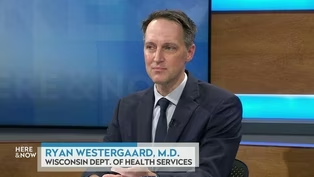
>> Wisconsin is experiencing one of the largest measles outbreaks in several years.
At last count, the Department of Health Services has identified 48 cases and one hospitalization, mostly in the southwest part of the state, and the case count has grown rapidly due to how highly contagious measles is among the unvaccinated.
With the latest, we're joined by Doctor Ryan Westergaard, chief medical officer with the Wisconsin DHS Bureau of Communicable Disease.
And doctor, thanks very much for being here.
>> Thank you for having me.
>> Describe how fast this has spread in this latest outbreak.
>> Well, unlike some previous outbreaks, we didn't catch this one at the very beginning.
We we identified cases that may have been associated with some families that had symptoms for a few weeks.
So it might even have been going on for a month.
When we did first detect it a couple of weeks ago, it's doubled about every 4 or 5 days.
So we started with just two cases confirmed.
Now we're up to 48.
So that number goes up when our investigators and local in the community, following up on people who report symptoms, identifying contacts, and when they find people with note with new symptoms, or they hear about a new test, that number goes up.
So this is often what we see with measles outbreaks.
>> How do public health officials get a handle on it?
>> Yeah, it's it's pretty painstaking.
And we give them so much, so much credit for their dedication out in the communities.
So measles is one of the reportable conditions.
So every positive lab test and every diagnosis made in a clinic we hear about in public health and here in Wisconsin, it's our local health departments, usually at the county or sometimes the city level that are the front line.
So where I work at the state health department, we we support, we aggregate the data, but the work that gets done in the community is involves every single person who is identified with measles gets an interview where an investigator, sometimes a public health nurse or a full time disease investigator will meet with them in person, face to face with.
With.
Personal protective equipment when.
When needed, and they'll confidentially try to understand places and people where they've been in contact.
And then we can then spread out and identify other people who have been exposed, give them the advice that they need about to double check their vaccination status or to get a post-exposure prophylaxis, meaning a vaccine.
And, and so that's, that's the work that's being done right now.
And we're probably going to see more cases as a result of those investigations.
>> With childhood vaccination rates, including for measles sitting at about 85% for incoming kindergartners in Wisconsin.
Was it just a matter of time before this outbreak happened?
>> I think the answer is yes to that.
We've we've been concerned about the level of childhood vaccinations being too low.
Measles, as you said, is probably our most contagious virus.
And the classical teaching in public health school is that you really need to have a community with 95% vaccine coverage or greater to prevent an outbreak.
If there is a case that comes into the community through travel, for example.
So we have many communities that are below 90 and below 85%.
And so for the past year and a half, where there have been measles outbreaks occurring in different places of the country, we've kind of been anticipating when is it going to come to Wisconsin.
The benefit of that is that we were ready and we're we're making the right resources available to our southwestern counties, and hopefully we'll take this what is now a medium sized outbreak and keep it that small and prevent it from getting to be a large one like we've seen in some other states.
get measles?
>> Measles is can be a pretty serious infection.
And it's a it's a good question to ask and to talk about, because there's been so little measles around in this country for so long that many physicians that are my generation or younger have never seen a case.
So measles can is a respiratory virus.
So it spreads through the air, which is what makes it so contagious.
The other side of the room, particles can remain suspended in the air and cause an infection.
But when it gets into the body, through the nose or mouth mouth, it causes a whole body.
A systemic infection causes high fever, sometimes as high as 105, a whole body rash that is, the characteristic dense red measles rash that starts on the head and then spreads to the whole body.
And so most anyone that gets measles will have those symptoms and feel pretty terrible.
But a subset of people with measles can get really severe illness, and it can cause pneumonia and cause encephalitis or swelling of the brain.
And sometimes, particularly in children, that brain inflammation can cause permanent disabilities like blindness or deafness.
So so it's a serious it's a serious infection, one that we want to prevent.
And our goal is to is to eliminate measles.
So there's actually not spreading in our communities at all.
And that's why the stakes are kind of high.
there was a measles vaccine?
>> Yeah.
The measles vaccine or version of the measles vaccine was released in 1963.
So a good long time ago and the decades before that, essentially everyone got measles during childhood.
Right.
And so that's why there's some misconception that this is a sort of a normal part of childhood.
But what we don't remember is that when 3 to 4 million children in the US get measles in a year like they did in the 50s and 60s, that means that several hundred children, young babies, will will die from the serious complications.
So in that decade before we had MMR vaccine, there were 3 to 400 deaths in children per year.
>> Doctor Ryan Westergaard, thanks very much for your update.
>> Yeah, thanks for being for having me.
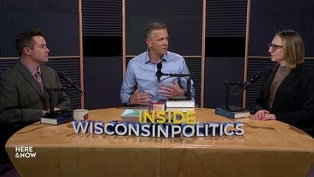
>> Turning to this week's Inside Wisconsin politics.
Our panel of reporters discussed the campaign implications of data centers and how the candidates for governor are treating the brand new wedge issue.
>> As far as wedge issues go, it's fairly clever.
This is a relatively new issue to politics, so it's not defined in the way that some other issues are.
You don't know exactly where the interest groups stand with the parties.
So Ana how is that playing out in this attack from Tom Tiffany?
How is he going after David Crowley trying to frame him?
>> Yeah, I mean, he's trying to use his initials against him.
He's calling him Data Data Center.
David Crowley DC, DC as a way of trying to kind of tie him to this.
And the way he's doing it is in a slightly convoluted way by saying that because David Crowley hasn't pledged to kind of roll back these specific tax incentives, that that makes him more pro data center.
David Crowley is also kind of trying to split the difference a little bit and say, well, I support local control.
So communities that don't want it don't have to have it.
I would want, you know, sort of tight controls and regulations in this kind of thing.
But the other kind of interesting piece of how Tom Tiffany is handling this.
So I went yesterday to an endorsement announcement for these environmental groups that are now backing David Crowley.
And of course, environmental concerns are very tied up in people's concerns over data centers.
And part of the way that that Tom Tiffany is now framing it is that data centers are taking away farmland.
And also because there's a push from Democrats to have sustainable energy, be sort of the backbone of data centers.
He's also now kind of using it as a one, two, three punch of they're trying to take farmland, not just to create data centers, but also to create wind farms and solar farms.
And so he can kind of package it together in all of these things that will speak to Republican voters.
Democrats obviously, like solar, like wind farms.
And so they'll have more of their work cut out for them to kind of distinguish those issues.
seeing some social media appearances from Tom and he's kind of framing it as data centers versus farmland.
It's maybe like a pretty transparent appeal to rural voters in that instance.
>> It's doing so many things at the same time because it is about his base and rural farmland.
One of his earliest ads months ago talked about how to prevent foreign countries from coming in and buying up our farmland, which is an issue that does concern people that are worried about the rising cost of just trying to rent out a field to put crops in the ground, as we've seen with all the international tariffs affecting soybean and corn farmers, they're looking for someone to blame.
And if they're some of the cognitive dissonance for them is they don't want to blame Donald Trump.
I've interviewed them, and they don't really want to blame him and his decisions.
So if they Tom Tiffany says, well, it's not his fault.
It's over here.
This is who you blame for your rising costs.
Well, they're more than happy to follow along if they're if they're in that inclination to begin with.
So it's definitely a way to do that.
But what's another element that's trying to split off those Hong voters from David Crowley and split the left, because we've seen elections where the far left and progressive left have sat out.
Maybe not in huge numbers, but enough numbers where potentially it does swing an election.
We saw that with Hillary Clinton.
We saw that with Kamala Harris, and they're trying to repeat that pattern with David Crowley.
If they can paint him as more moderate, more corporate and less true, far left than some of those voters may go third party or just set out together.
And that's one of the concerns, is he has to watch his flank, even though he won by being in the center.
>> That's definitely an open question for me, especially because you at least get the impression that a lot of Hong voters are maybe not a politics first kind of voter.
You know, they came to her because she spoke to them in different ways, more of a movement candidate.
She would not want to identify with Donald Trump, but a movement candidate in that way.
You get different people into the political arena.
And, you know, one question that I think some of them had during the primary was, why don't more Democrats just say what Francesca Hong is saying?
We're going to have a moratorium on data centers.
I like the sounds of that.
Why wouldn't David Crowley Ana just say, hey, let's let's put the brakes on these.
And this data center issue is all taken care of for me politically.
>> Well, politically speaking, data centers are not popular.
The vast majority of voters, Democrats and Republicans, don't support data centers, or they certainly don't support them sort of coming into their own communities.
But there is a real kind of question around the types of jobs that they can bring in, the kind of economic development possibilities there.
And so I think like as a politician, you don't necessarily want to say, you know, categorically, I will not support a thing that could be a driver of economic growth, especially in some of these kind of hard hit places in Wisconsin that are kind of hurting for economic opportunities.
You know, is that a lot of the the data center, a lot of the unions that Bakke David Crowley are involved in data center construction.
And so one of the things that he has said is that, you know, again, if a local community wants a data center, one of the things that he would want to see is that it has to be union built.
That gets you union support.
And unions are a pretty big part of how the Democratic Party defines itself as being a party of the unions.
And unions are a pretty big part of how Republicans have started to kind of make huge inroads with working people.
So the union question, I think, is an untapped and unanswered one so far.
>> Look for reporting from Murv Seymour on what community members think about data centers.
That's next Friday on this program.
In other state news, the UW system is trying to make a deal with the state legislature.
Under the plan announced this week by the UW Board of Regents, tuition at state public universities would be frozen for the 2729 biennium.
If the state legislature agrees to invest $190 million in the Universities of Wisconsin system.
Also part of the deal, UW campuses would promise to cap tuition at the rate of inflation for two years following the tuition freeze.
The Board of Regents also announced a new program called Wisconsin Work and Learn.
It would eliminate tuition for in-state residents, students whose families earn at or below the median household income.
In exchange, students would have to commit to taking part in work, internship or apprenticeship programs.
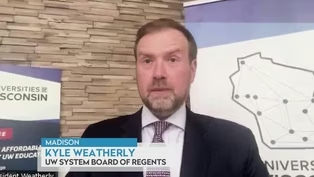
Board of Regents President Kyle Weatherly said these two proposals will make Wisconsin public universities more financially attractive to students.
>> Together, these proposals would make the University of Wisconsin the most affordable in the Midwest.
They would provide families with greater certainty, remove financial barriers for thousands of students, and reaffirm Wisconsin's long standing belief that talent and hard work, not financial circumstances, should determine a student's opportunity to succeed.
>> We should note that PBS Wisconsin is a part of UW-Madison.
Trying to make college more affordable could help the problem of student loan defaults.
Thousands of people across Wisconsin are not keeping up with repayment of student loans, according to Wisconsin Watch, more than 100,000, or 15% of borrowers in the state carry loans that are in default, having not made a payment in 360 days.
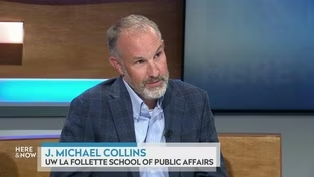
What kind of a bellwether is this for the overall economy, and what's the consequence?
We turn to Jay Michael Collins, a consumer finance expert and professor at the La Follette School of Public Affairs.
And thanks very much for being here.
>> Thanks for having me.
>> So what kind of a marker are student loan defaults for larger economic struggles?
>> I mean, it is a little bit of a canary in the coal mine because if you think about it, many people who have student loans also have credit card loans.
They might have mortgages, auto loans.
These are the loans that they probably have delayed on making payments on.
So once they get behind on these loans, there could be a cascade where they get fall behind on their credit card loans and other kinds of loans.
So it is it is something that's very concerning.
>> How predictable is it that people who hold potentially hefty student loans wouldn't be able to repay them once the Biden era help kind of phased out?
>> There's a lot of different things going on.
I mean, the Biden era help was also with the pandemic.
And so there was this long period where no payments were required, almost three years.
So now borrowers have to get back in the habit of making payments again.
Simultaneously, though, we change the rules, meaning the federal government changed the rules.
And so even a conscientious borrower is going to have a hard time when the payment plans are changing, when they're getting opted into plans, if they don't take an action.
So that's made it really hard, I think, for people to try to keep up with what the current rules and regulations are.
>> What's an example of how payments might have ballooned when these favorable repayment plans went away?
>> I mean, one of the examples is we had at one point in time, we had probably too many different repayment plans that people could opt into.
But the sort of standard plan today would result in borrowers who were in a repayment plan before seeing their payments go up at least $500 a month.
So that's a big, big shift, especially when they were maybe paying very little during the Covid period.
Other plans, you actually have to take action to step up and get to your servicer.
That means standing in, standing in a virtual line for the phone or otherwise trying to get reach them.
And it's been really hard.
There's a big backlog to try to get access to that help that you need.
for people who actually go into default on these loans?
>> The the big issue with student loans, unlike almost all other forms of debt, is these are unsecured loans and they don't go away in bankruptcy.
So you have to pay them back.
If you don't, your wages will be garnished.
Even your Social Security could be garnished as you get older.
So there really is no recourse but to pay these loans back.
Most of the new payment plans are actually stretching payments now over 30 years.
So that's quite a long time to have that burden of payments that you have to take care of.
>> Meanwhile, consumer spending ticked down this summer and job numbers were revised down.
How was the rate of inflation, the higher cost of things dragging down the economy amidst all of the rest of what.
>> We've talked?
I mean, the surveys of consumer sentiment that the University of Michigan and other places do are all ticking downwards.
People seem troubled.
I think, you know, if you look at the inflation numbers, it's not terrible outside of particularly oil.
But what people really feel like is that their wages aren't keeping up.
In other words, the the paycheck is not going up as much as prices for everything else.
And so in lots of surveys, people think that they will actually their budget will be worse off this year because their raises and their income won't match their cost of living.
And so that's really that squeeze that people are feeling and making it hard to keep up with everything, including student loans.
>> And meanwhile, you also say that September 4th is a day that people will be looking ahead to why.
>> Right now, the information that we have, the data we have is pretty mixed.
So consumer sentiment seems kind of weak.
You know, inflation numbers, like a lot of the numbers are just kind of very middling.
And so it's hard to look at the numbers and draw any conclusions.
But the last jobs report, as you mentioned, was pretty negative.
And so this next jobs report will really tell us if this is a trend, if we see another really weak jobs report that suggests that places aren't hiring, maybe places are even letting people go.
We worry about what this fall might look like in terms of higher unemployment as well.
>> Speaking of that, the economy polls as a key election issue, as it always does.
What is it like out there for the average voter in Wisconsin kind of heading into the midterms?
>> Yeah.
I mean, this anxiety that people feel, this worry, that people feel they take it out in lots of different ways.
And so one of those ways is the government isn't doing it for me.
And so I think this will particularly be hard for any incumbent, particularly anybody who's associated with the current administration, is going to have to sort of make an argument that they didn't contribute to the problems.
It's not clear that what any politician can do, in the light of the current economic, economic situation, but it certainly is making voters very anxious and perhaps a little bit rebellious in their votes this year.
>> And your crystal ball would suggest that potentially it won't get better before November.
>> The numbers have shown us, if anything, more negative signals than positive signals.
So maybe things won't be getting as worse as the worst case scenario, but it looks very unlikely it's going to get a lot better.
>> All right.
Well, thank you for your insights, J. Michael Collins.
Finally tonight, you've probably driven past one but may not have noticed it.
Automated license plate readers or alpr cameras are small and usually found near stoplights and street signs on roads and intersections across the country.
These cameras have grown in popularity and in controversy over recent years.
Here and now reporter Steven Potter looked into their use around Wisconsin.
>> There's nothing flashy about Alpr cameras, and that's on purpose.
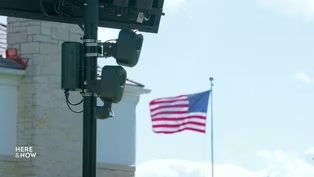
These automated license plate reading devices sit inconspicuously, usually on a pole and under a solar panel.
They automatically read your license plate and retain an image of your car with a date and a time stamp of when you went past it.
That information and image is then sent off to the law enforcement agency that contracted with the company that operates the cameras.
They're commonly called flock cameras, after the most popular brand that makes and deploys the devices according to groups that track them.
There are an estimated 130,000 such cameras in the United States.
In Wisconsin, it's estimated there are as many as 2000 of the cameras used by more than 200 law enforcement agencies.
But over the last couple of years, flock and other similar companies have been catching flak from opponents concerned about privacy, calling them tools of mass surveillance that operate without a warrant.
Critics say the cameras invade an individual's privacy before and without prior knowledge of any crime being committed.
Groups like the American Civil Liberties Union calls the cameras creepy and says that the storage of images and information in national databases lacks regulation.
Opposition to the cameras is showing up in Wisconsin, with reports of them being vandalized and taken down.
And many governments around Wisconsin are taking action against them.
So far, Dane County, as well as cities such as Fitchburg, Stoughton, Monona and others, have stopped, canceled or not renewed contracts with the Flock Safety Company.
And in the city of Verona, officials put bags over the flock cameras after the company didn't move fast enough to remove them.
The largest user of flock cameras in Wisconsin is the City of Milwaukee Police Department.
Cases of misuse of the technology by people with access to the cameras are also cropping up.
In mid-August, a Menasha police officer was sentenced for using flock cameras for illegal surveillance, and two Milwaukee police officers have been criminally charged with illegally tracking people using the cameras.
Those who are in favor of these cameras and tracking devices say they are an invaluable law enforcement tool that helps apprehend those who commit crimes of all kinds, ranging from driving infractions to car theft and more serious offenses.
The topic of flock and alpr cameras came up in the most recent episode of In Focus with Murv Seymour, where he interviewed former Madison police chief Noble Rae.
>> Where it becomes a question is proactively how it is used.
So if I'm using this information and then I act on it, even if you have not committed a crime right then and there I go, knock on your door and say, hey, you came through this, this intersection at such and such date and time.
This is a potential.
And based upon the information we have, you have a warrant for your arrest.
So people ask those questions or you, you, you were here and you're being surveilled.
Now people complain about the issues of privacy.
>> And what's done with that information once it's gathered, what happens to it at that point?
>> That's that's another issue in the, in, in most states, information has been historically treated.
And there are laws that govern how long you can maintain a record.
Where does the information go, who has access to it?
So one of the other concerns that communities need to wrestle with is that if if a third party has data and information and if the government has access to that, have they made that third party become a de facto part of the government because they're accessing their information?
But where is that stored?
What information do they have on you?
Don't you have a right to know what your government has on you?
These are questions that communities really do need to wrestle with.
>> Yeah.
And we and we know that some law enforcement agencies, departments around the state have been moving away from that system.
Why do you think it's so controversial and why would they move away from it?
You think?
>> I think first of all, I think it was developed in many instances to improve public safety.
I'm not going to conclude that that was not the reason.
But I think that right now we're behind the curve.
We are behind the curve because we have not, as a community provided what what they should be used for, what are the standards, what are the standards of privacy that that community accepts?
How should the police department use it?
Some communities have gone, and what they've done is that they've pulled together stakeholders and they've discussed from every every branch they pull together people that are, you know, community members, civil liberties they've pulled together, people that are subject matter experts, the manufacturers, and they broad guidelines.
And then the community starts to lay out for law enforcement.
Here's some policies, here are some procedures, here are some ordinances that we think would work.
And they all have to be constantly improved.
But right now we're behind the eight ball because we have not done that.
And so we're we're reaching for this technology before we know its total impact and we're using it before we know the total impact.
>> For full episodes of In Focus with Murv Seymour and Inside Wisconsin Politics, plus more of our reporting on issues facing Wisconsin, visit our website at PBS wisconsin.org.
That's our program for tonight.
I'm Frederica Freyberg.
Have a good weekend.
>> Funding for "Here& Now" is provided by the Focus Fund for Journalism and friends of PBS Wisconsin.
 New
NewDr. Ryan Westergaard on Measles Cases in Southwest Wisconsin
Video has Closed Captions
Clip: S2500 Ep2508 | 5m 44s | Dr. Ryan Westergaard on a measles outbreak and falling childhood vaccination rates. (5m 44s)
 New
NewHere & Now opening for August 21, 2026
Video has Closed Captions
Clip: S2500 Ep2508 | 1m 22s | The introduction to the August 21, 2026 episode of Here & Now. (1m 22s)
 New
NewInside Wisconsin Politics: Data Centers in the Governor Race
Video has Closed Captions
Clip: S2500 Ep2508 | 5m 23s | Inside Wisconsin Politics on how data centers are a wedge issue in the governor's race. (5m 23s)
 New
NewJ. Michael Collins on Student Loan Defaults and the Economy
Video has Closed Captions
Clip: S2500 Ep2508 | 5m 35s | J. Michael Collins on the rising number of student loan borrowers who are in default. (5m 35s)
 New
NewThe Rise of and Opposition to Flock Cameras in Wisconsin
Video has Closed Captions
Clip: S2500 Ep2508 | 2m 49s | Widespread automated license plate reader use has provoked a vocal surge of opposition. (2m 49s)
 New
NewUW System Pushes for Tuition Freeze in Return for Investment
Video has Closed Captions
Clip: S2500 Ep2508 | 1m 29s | The UW Board of Regents plans to freeze tuition if the state invests in the system. (1m 29s)
Providing Support for PBS.org
Learn Moreabout PBS online sponsorship New Episode
- News and Public Affairs

Top journalists deliver compelling original analysis of the hour's headlines.
 New Episode
- News and Public Affairs

Today's top journalists discuss Washington's current political events and public affairs.

 New Episode
 New Episode
 New Episode
 New Episode

 New Episode
 New Episode
 New Episode
Support for PBS provided by:
Here and Now is a local public television program presented by PBS Wisconsin